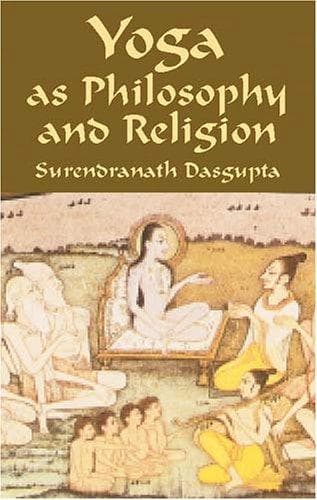
Yoga as philosophy and religionDasgupta, Surendranath
Religion
Yoga as philosophy and religion
Dasgupta, Surendranath
Hindu philosophy; Patañjali; Yoga
“But like the senses the tanmātras are also special modifications of the
ahaṃkāra having specially modified characteristics such as sound, touch,
etc., why, therefore, are they not mentioned as special modifications
(_viśeshas_)? The answer is that those only are mentioned as special
modification which are ultimate special modifications. The tanmātras are
indeed the special modifications of the ego, but they themselves produce
further special modifications, the bhūtas. The aviśeshas are explained
as the six aviśeshas. The tanmātras are generated from the tāmasa
ahaṃkāra gradually through sound, etc. The category of mahat which is
the ground of all modifications, called also the buddhi, has six
evolutionary products called the aviśeshas. Though the mahat and the
prakṛti may also be regarded as the root-causes out of which the
tanmātras have evolved, yet the word aviśesha is used as a technical
term having a special application to the six aviśeshas only.” The
modifications of these are from the buddhi through the intermediate
stage of the ahaṃkāra, as has been explained in the _Bhāshya_, I. 45.
Thus we see that the _Yoga-vārttika_ says that the _Bhāshya_ is here
describing the modifications of buddhi in two distinct classes, the
aviśeshas and the viśeshas; and that the mahat has been spoken of as the
source of all the aviśeshas, the five tanmātras and the ego; strictly
speaking, however, the genesis of the tanmātras from mahat takes place
through the ego and in association with the ego, for it has been so
described in the _Bhāshya_, I. 45.
Nāgeśa in explaining this _Bhāshya_ only repeats the view of
_Yoga-vārttika_.
Now let us refer to the _Bhāshya_ of I. 45, alluded to by the
_Yoga-vārttika_: “The gradual series of subtler causes proceeds up to
the aliṅga or the prakṛti. The earth atom has the smell tanmātra as its
subtle cause; the water atom has the taste tanmātra; the air atom the
touch tanmātra; the ākāśa atom the sound tanmātra; and of these ahaṃkāra
is the subtle cause; and of this the mahat is the subtle cause.” Here by
subtle cause (_sūkshma_) it is upādānakāraṇa or material cause which is
meant; so the _Bhāshya_ further says: “It is true that purusha is the
subtlest of all. But yet as prakṛti is subtler than the mahat, it is not
in that sense that purusha is subtler than prakṛti for purusha is only
an instrumental cause of the evolution of mahat, but not its material
cause.” I believe it is quite clear that ahaṃkāra is spoken of here as
the _sūkshma anvayikārana_ of the tanmātras. This anvayikāraṇa is the
same as upādāna (material cause) as Vācaspati calls it. Now again in the
_Bhāshya_ of the same _sūtra_ II. 19 later on we see the liṅga or the
mahat is the stage next to prakṛti, it is differentiated from it though
still remaining integrated in the regular order of evolution. The six
aviśeshas are again differentiated while still remaining integrated in
the mahat in the order of evolution (_pariṇāmakramaniyama_).
Public-domain text, read in full here on John Shaqi.
Reviews
Reviews
No reviews yet
Be the first to share your thoughts on this work.
Join the Discussion
Join the discussion
Sign in to leave a comment or review.
Sign InorCreate an account