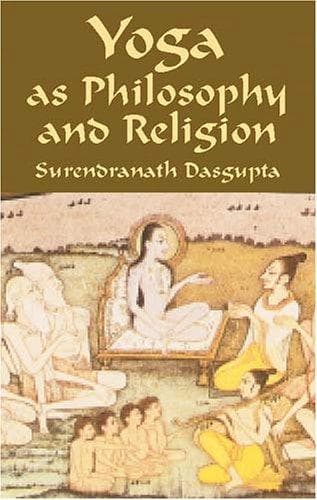
Yoga as philosophy and religionDasgupta, Surendranath
Religion
Yoga as philosophy and religion
Dasgupta, Surendranath
Hindu philosophy; Patañjali; Yoga
smallest amount of change—viz. that of an atom of its own amount of
space. Now here the appearance is called the dharma, and that particular
arrangement of atoms or guṇas which is the basis of the particular
appearance is called the dharmin. The change of appearance is therefore
called the dharma-pariṇāma.[35]
Again this change of appearance can be looked at from two other aspects
which though not intrinsically different from the change of appearance
have their own special points of view which make them remarkable. These
are _lakshaṇa-pariṇāma_ and _avasthā-pariṇāma_. Taking the particular
collocation of atoms in a body for review, we see that all the
subsequent changes that take place in it exist in it only in a latent
way in it which will be manifested in future. All the previous changes
of the collocating atoms are not also lost but exist only in a sublatent
way in the particular collocation of atoms present before us. For the
past changes are by no means destroyed but are preserved in the peculiar
and particular collocation of atoms of the present moment. For had not
the past changes taken place, the present could not appear. The present
had held itself hidden in the past just as the future is hidden within
the present. It therefore only comes into being with the unfolding of
the past, which therefore exists only in a sublatent form in it.
It is on account of this that we see that a body comes into being and
dies away. Though this birth or death is really subsumed the change of
appearance yet it has its own special aspect, on account of which it has
been given a separate name as lakshaṇa-pariṇāma. It considers the three
stages of an appearance—the unmanifested when it exists in the future,
the manifested moment of the present, and the past when it has been
manifested—lost to view but preserved and retained in all the onward
stages of the evolution. Thus when we say that a thing has not yet come
into being, that it has just come into being, and that it is no longer,
we refer to this lakshaṇa-pariṇāma which records the history of the
thing in future, present and past, which are only the three different
moments of the same thing according to its different characters, as
unmanifested, manifested and manifested in the past but conserved.
Public-domain text, read in full here on John Shaqi.
Reviews
Reviews
No reviews yet
Be the first to share your thoughts on this work.
Elsewhere in the archive
Join the Discussion
Join the discussion
Sign in to leave a comment or review.
Sign InorCreate an account