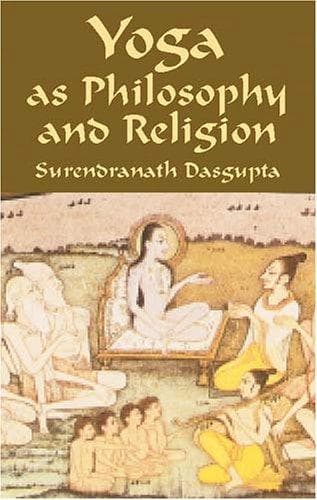
Yoga as philosophy and religionDasgupta, Surendranath
Religion
Yoga as philosophy and religion
Dasgupta, Surendranath
Hindu philosophy; Patañjali; Yoga
Again, these atoms, though so much unlike the Vaiśeshika atoms since
they contain tanmātras of a different nature as their constituents and
thus differ from the simpler atoms of the Vaiśeshikas, compose the
constituents of all inorganic, organic or animal bodies in such a way
that there is no break of harmony—no opposition between them;—but, on
the contrary, when any one of the guṇas existing in the atoms and their
conglomerations becomes prominent, the other guṇas though their
functions are different from it, yet do not run counter to the prominent
guṇas, but conjointly with them, help to form the specific modification
for the experiences of the purusha. In the production of a thing, the
different guṇas do not choose different independent courses for their
evolution, but join together and effectuate themselves in the evolution
of a single product. Thus we see also that when the atoms of different
gross elements possessing different properties and attributes coalesce,
their difference of attributes does not produce confusion, but they
unite in the production of the particular substances by a common
teleological purpose (see _Vyāsa-bhāshya_, IV. 14).
We thus see that the bodies or things composed by the collocation of the
atoms in one sense differ from the atoms themselves and in another are
identical with the atoms themselves. We see therefore that the
appearance of the atoms as bodies or things differs with the change of
position of the atoms amongst themselves. So we can say that the change
of the appearance of things and bodies only shows the change of the
collocation of the atoms, there being always a change of appearance in
the bodies consequent on every change in the position of the atoms. The
former therefore is only an explicit appearance of the change that takes
place in the substance itself; for the appearance of a thing is only an
explicit aspect of the very selfsame thing—the atoms; thus the _Bhāshya_
says: _dharmisvarūpamātro hi dharmaḥ, dharmivrikriyā eva eshā
dharmadvārā prapañcyate_, i.e. a dharma (quality) is merely the nature
of the dharmin (substance), and it is the changes of the dharmin that
are made explicit by the dharmas.[34] Often it happens that the change
of appearance of a thing or a body, a tree or a piece of cloth, for
example, can be marked only after a long interval. This, however, only
shows that the atoms of the body had been continually changing and
consequently the appearance of the body or the thing also had been
continually changing; for otherwise we can in no way account for the
sudden change of appearance. All bodies are continually changing the
constituent collocation of atoms and their appearances. In the smallest
particle of time or kshaṇa the whole universe undergoes a change. Each
moment or the smallest particle of time is only the manifestation of
that particular change. Time therefore has not a separate existence in
this philosophy as in the Vaiśeshika, but it is only identical with the
Public-domain text, read in full here on John Shaqi.
Reviews
Reviews
No reviews yet
Be the first to share your thoughts on this work.
Elsewhere in the archive
Join the Discussion
Join the discussion
Sign in to leave a comment or review.
Sign InorCreate an account