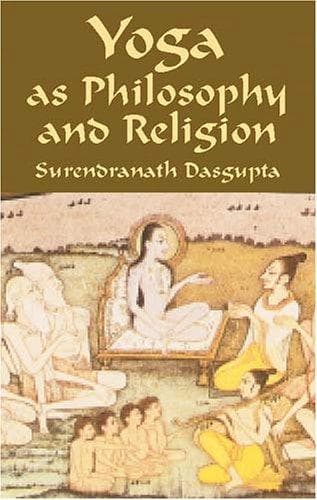
Yoga as philosophy and religionDasgupta, Surendranath
Religion
Yoga as philosophy and religion
Dasgupta, Surendranath
Hindu philosophy; Patañjali; Yoga
But its dharma, as the shape of the jug may be thought to have itself
undergone a change—inasmuch as it has now come into being, from a state
of relative non-being, latency or unpredicability. This is called the
lakshaṇa-pariṇāma of the dharma or qualities as constituting a jug. This
jug is again suffering another change as new or old according as it is
just produced or is gradually running towards its dissolution, and this
is called the avasthā-pariṇāma or change of condition. These three,
however, are not separate from the dharma-pariṇāma, but are only aspects
of it; so it may be said that the dharmin or substance directly suffers
the dharma-pariṇāma and indirectly the lakshaṇa and the
avasthā-pariṇāma. The dharma, however, changes and the lakshaṇa-pariṇāma
can be looked at from another point of view, that of change of state,
viz. growth and decay. Thus we see that though the atoms of kshiti, ap,
etc., remain unchanged, they are constantly suffering changes from the
inorganic to plants and animals, and from thence again back to the
inorganic. There is thus a constant circulation of changes in which the
different atoms of kshiti, ap, tejas, vāyu and ākāśa remaining
themselves unchanged are suffering dharma-pariṇāma as they are changed
from the inorganic to plants and animals and back again to the
inorganic. These different states or dharmas (as inorganic, etc.),
again, according as they are not yet, now, or no longer or passed over,
are suffering the lakshaṇa-pariṇāma. There is also the avasthā-pariṇāma
of these states according as any one of them (the plant state for
example) is growing or suffering decay towards its dissolution.
This circulation of cosmic matter in general applies also to all
particular things, such as the jug, the cloth, etc.; the order of
evolution here will be that of powdered particles of earth, lump of
earth, the earthen jug, the broken halves of the jug, and again the
powdered earth. As the whole substance has only one identical evolution,
these different states only happen in order of succession, the
occurrence of one characteristic being displaced by another
characteristic which comes after it immediately. We thus see that one
substance may undergo endless changes of characteristic in order of
succession; and along with the change of characteristic or dharma we
have the lakshaṇa-pariṇāma and the avasthā-pariṇāma as old or new, which
is evidently one of infinitesimal changes of growth and decay. Thus
Vācaspati gives the following beautiful example: “Even the most
carefully preserved rice in the granary becomes after long years so
brittle that it crumbles into atoms. This change cannot happen to new
rice all on a sudden. Therefore we have to admit an order of successive
changes” (_Tattvavaivśāradī_, III. 15).
Public-domain text, read in full here on John Shaqi.
Reviews
Reviews
No reviews yet
Be the first to share your thoughts on this work.
Elsewhere in the archive
Join the Discussion
Join the discussion
Sign in to leave a comment or review.
Sign InorCreate an account