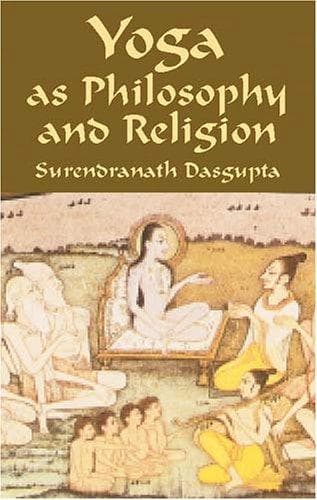
Yoga as philosophy and religionDasgupta, Surendranath
Religion
Yoga as philosophy and religion
Dasgupta, Surendranath
Hindu philosophy; Patañjali; Yoga
It is the object of Yoga gradually to restrain the citta from its
various states and thus cause it to turn back to its original cause, the
kāraṇacitta, which is all-pervading. The modifications of the
kāraṇacitta into such states as the kāryyacitta is due to its being
overcome by its inherent tamas and rajas; so when the transformations of
the citta into the passing states are arrested by concentration, there
takes place a backward movement and the all-pervading state of the citta
being restored to itself and all tamas being overcome, the Yogin
acquires omniscience, and finally when this citta becomes as pure as the
form of purusha itself, the purusha becomes conscious of himself and is
liberated from the bonds of prakṛti.
The Yoga philosophy in the first chapter describes the Yoga for him
whose mind is inclined towards trance-cognition. In the second chapter
is described the means by which one with an ordinary worldly mind
(_vyutthāna citta_) may also acquire Yoga. In the third chapter are
described those phenomena which strengthen the faith of the Yogin on the
means of attaining Yoga described in the second chapter. In the fourth
chapter is described kaivalya, absolute independence or oneness, which
is the end of all the Yoga practices.
The _Bhāshya_ describes the five classes of cittas and comments upon
their fitness for the Yoga leading to kaivalya. Those are I. _kshipta_
(wandering), II. _mūḍha_ (forgetful), III. _vikshipta_ (occasionally
steady), IV. _ekāgra_ (one-pointed), _niruddha_ (restrained).
I. The _kshiptacitta_ is characterised as wandering, because it is being
always moved by the rajas. This is that citta which is always moved to
and fro by the rise of passions, the excess of which may indeed for the
time overpower the mind and thus generate a temporary concentration, but
it has nothing to do with the contemplative concentration required for
attaining absolute independence. The man moved by rajas, far from
attaining any mastery of himself, is rather a slave to his own passions
and is always being moved to and fro and shaken by them (see
_Siddhānta-candrikā_, I. 2, _Bhojavṛtti_, I. 2).
II. The mūḍhacitta is that which is overpowered by tamas, or passions,
like that of anger, etc., by which it loses its senses and always
chooses the wrong course. Svāmin Hariharāraṇya suggests a beautiful
example of such concentration as similar to that of certain snakes which
become completely absorbed in the prey upon which they are about to
pounce.
III. The vikshiptacitta, or distracted or occasionally steady citta, is
that mind which rationally avoids the painful actions and chooses the
pleasurable ones. Now none of these three kinds of mind can hope to
attain that contemplative concentration called Yoga. This last type of
mind represents ordinary people, who sometimes tend towards good but
relapse back to evil.
Public-domain text, read in full here on John Shaqi.
Reviews
Reviews
No reviews yet
Be the first to share your thoughts on this work.
Elsewhere in the archive
Join the Discussion
Join the discussion
Sign in to leave a comment or review.
Sign InorCreate an account