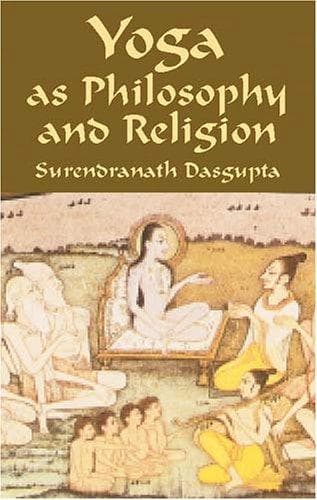
Yoga as philosophy and religionDasgupta, Surendranath
Religion
Yoga as philosophy and religion
Dasgupta, Surendranath
Hindu philosophy; Patañjali; Yoga
Vijñāna Bhikshu and his follower Nāgeśa, however, say that the
dṛshṭajanmavedanīya karma (to be fructified in the same visible life)
can never be ekabhavika or unigenital for there is no bhava, or previous
birth there, whose product is being fructified in that life, for this
karma is of that same visible life and not of some other previous bhava
or life; and they agree in holding that it is for that reason that the
_Bhāshya_ makes no mention of this dṛshṭajanmavedanīya karma; it is
clear that the karmāśaya in no other bhava is being fructified here.
Thus we see that about dṛshṭajanmavedanīya karma, Vācaspati holds that
it is the typical case of ekabhavika karma (karma of the same birth),
whereas Vijñāna Bhikshu holds just the opposite view, viz. that the
dṛhṭajanmavedanīya karma should by no means be considered as ekabhavika
since there is here no bhava or birth, it being fructified in the same
life.
The adṛshṭajanmavedanīya karma (works to be fructified in another life)
of unfixed fruition has three different courses: (I) As we have observed
before, by the rise of _aśuklākṛshṇa_ (neither black nor white) karma,
the other karmas—_śukla_ (black), _kṛshṇa_ (white) and _śuklakṛshṇa_
(both black and white)—are rooted out. The śukla karmāśaya again arising
from study and asceticism destroys the kṛshṇa karmas without their being
able to generate their effects. These therefore can never be styled
ekabhavika, since they are destroyed without producing any effect. (II)
When the effects of minor actions are merged in the effects of the major
and ruling action. The sins originating from the sacrifice of animals at
a holy sacrifice are sure to produce bad effects, though they may be
minor and small in comparison with the good effects arising from the
performance of the sacrifice in which they are merged. Thus it is said
that the experts being immersed in floods of happiness brought about by
their sacrifices bear gladly particles of the fire of sorrow brought
about by the sin of killing animals at sacrifice. So we see that here
also the minor actions having been performed with the major do not
produce their effects independently, and so all their effects are not
fully manifested, and hence these secondary karmāśayas cannot be
regarded as ekabhavika. (III) Again the adṛshṭajanmavedanīya karma (to
be fructified in another life) of unfixed fruition (_aniyata vipāka_)
remains overcome for a long time by another adṛshṭajanmavedanīya karma
of fixed fruition. A man may for example do some good actions and some
extremely vicious ones, so that at the time of death, the karmāśaya of
those vicious actions becoming ripe and fit for appointed fruition,
generates an animal life. His good action, whose benefits are such as
may be reaped only in a man-life, will remain overcome until the man is
born again as a man: so this also cannot be said to be ekabhavika (to be
reaped in one life). We may summarise the classification of karmas
Public-domain text, read in full here on John Shaqi.
Reviews
Reviews
No reviews yet
Be the first to share your thoughts on this work.
Elsewhere in the archive
Join the Discussion
Join the discussion
Sign in to leave a comment or review.
Sign InorCreate an account