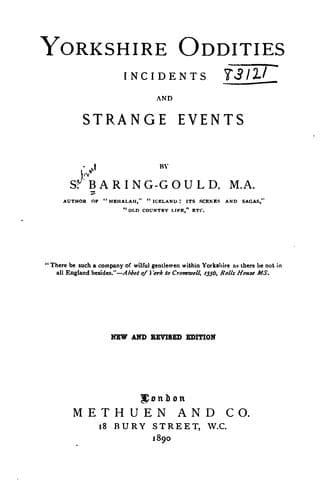
Yorkshire Oddities, Incidents, and Strange EventsBaring-Gould, S. (Sabine)
History
Yorkshire Oddities, Incidents, and Strange Events
Baring-Gould, S. (Sabine)
Legends -- England -- Yorkshire; Yorkshire (England) -- Miscellanea
to be done, for I have neither money nor clothes, having left all behind
at Falkirk; but I have bills upon the road to the amount of £300?" This
proved fortunate; for had they been a few days sooner, these also might
have been lost. The reason of the delay was that all letters directed to
Scotland were at this time sent to London to be examined at the General
Post-Office. Metcalf told the captain that he could get him some money,
but this the other thought impossible. However, he went to a friend and
obtained £30. Tailors were immediately set to work, and next morning the
captain was enabled to visit his brother officers at Holyrood.
The army remained quartered at Edinburgh, while part of the rebels were
in Falkirk, and another part at Stirling, where they raised several
batteries, and besieged Stirling Castle.
The Duke of Cumberland arrived at Edinburgh on the 30th of January,
1746; and two days afterwards marched at the head of the army towards
Falkirk, Prince Charles' army leaving it a little time before. Captain
Thornton visited the Duke often, and his Royal Highness took particular
notice of Metcalf, speaking to him several times on the march. On the
arrival of the army at Linlithgow, intelligence was received that the
rebels were marching towards them to give them battle; upon which the
army was drawn up in order, and the Duke rode through the lines, and
addressed the men as follows:--"If there be any who think themselves in
a bad cause, or are afraid to engage the enemy, thinking they may fight
against any of their relations, let them now turn out, receive pardon,
and go about their business without any further question." On the
conclusion of this speech, the whole army gave three hearty cheers. But
the intelligence proving false, they proceeded to Falkirk, and continued
their journey to Stirling, Perth, Montrose, Brechin, and Aberdeen, where
they halted. The army of the Prince was encamped at Strathbogie.
At Aberdeen the Duke gave a ball to the ladies, and personally solicited
Captain Thornton for his fiddler, there being at that time no music in
the army except Colonel Howard's (the Old Buffs), which was wind music,
and the performers, who were Germans, were unaccustomed to country
dances. As the Prince's army was only twenty miles distant, no
invitations were sent until five o'clock, though the ball was to begin
at six. Twenty-five couples danced for eight hours, and his Royal
Highness made one of the party, and several times as he passed Metcalf,
who stood on a chair to play, shouted, "Thornton, play up!" But Jack
needed no exhortation, for he was well practised and better inclined.
Public-domain text, read in full here on John Shaqi.
Reviews
Reviews
No reviews yet
Be the first to share your thoughts on this work.
Elsewhere in the archive
Join the Discussion
Join the discussion
Sign in to leave a comment or review.
Sign InorCreate an account