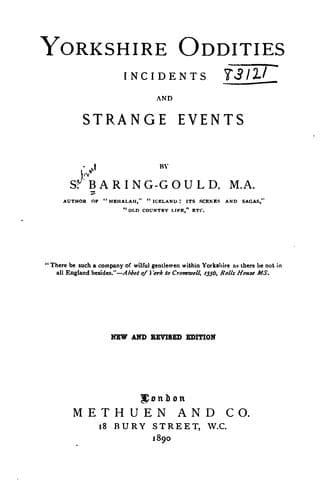
Yorkshire Oddities, Incidents, and Strange EventsBaring-Gould, S. (Sabine)
History
Yorkshire Oddities, Incidents, and Strange Events
Baring-Gould, S. (Sabine)
Legends -- England -- Yorkshire; Yorkshire (England) -- Miscellanea
Samuel Sutcliffe lived at Hebden Hay, or Hawden Hole, about a quarter of
a mile west of Newbridge, nearly at the bottom of the steep slope which
descends from Whitehill Nook to the river Hebden. The house is still
standing, easy to be recognised by its whitewash and by the yew-tree
which grows between the door and the path leading to Upper Hepton and
Tommy Rocky's. Beside the farmhouse there is under the same roof a
cottage at the east end. In the field at the west end, and below the
house, stretching down to the stream, were formerly some mounds, where
it was said that the Heptonstall people during the plague buried their
dead. Crabtree says (p. 15): "Of that dreadful epidemic, the plague, one
hundred and seventeen persons are said to have died at Heptonstall in
1631, several of whom were buried at home, but all entered in the
register there." In the old barn near the house, pulled down a few years
ago, since 1817, an old man cut his throat. The yew-tree is no inapt
symbol of the melancholy associations of this secluded spot--a cemetery,
a suicide, and a murder.
Samuel Sutcliffe, commonly called Sammy o' Kattie's, lived there to the
age of eighty, a bachelor. He was a manufacturer of worsted pieces, and
for several years farmed the small farm. The only person living with him
was his nephew, William Sutcliffe. On Saturdays, sometimes the uncle,
sometimes the nephew, attended Halifax market; sometimes both. On
Saturdays, towards evening, the old man might have been seen crossing
the old bridge at Hebden Bridge, and calling at the "Hole in the Wall"
to take a single glass of ale and hear the news, while he gave himself a
very brief rest after his walk from Halifax, before passing on. He was a
stout, active man for his age; sober, steady, and industrious; and by
economy, but without penuriousness, had saved a considerable sum of
money. The cottage adjoining Sammy's dwelling was inhabited by a weaver
named William Greenwood.
For five or six years the nephew, William Sutcliffe, had carried on a
little business in the fustian trade on his own account; and for two
years he had the take of the farm, on which he kept a couple of cows.
His business led him to travel into Lancashire, Craven, and even
Westmoreland. His journeys were taken three times a year: he started on
Monday morning, and returned usually on Friday evening, sometimes on
Saturday. He left Hawden Hole on one of these journeys on Monday,
February 3rd, 1817, and was this time expected home on the Thursday
night following, but circumstances prevented his return till the
Saturday.
Public-domain text, read in full here on John Shaqi.
Reviews
Reviews
No reviews yet
Be the first to share your thoughts on this work.
Elsewhere in the archive
Join the Discussion
Join the discussion
Sign in to leave a comment or review.
Sign InorCreate an account