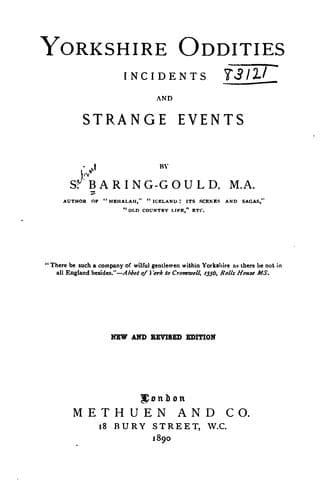
Yorkshire Oddities, Incidents, and Strange EventsBaring-Gould, S. (Sabine)
History
Yorkshire Oddities, Incidents, and Strange Events
Baring-Gould, S. (Sabine)
Legends -- England -- Yorkshire; Yorkshire (England) -- Miscellanea
Now, to corroborate my remarks upon
cheerfulness as conducive to contentment, I will by leave solicit so
much of your indulgence as to hear the following extract from the works
of an eminent divine of the Established Church:--The Thirty-Nine
Articles are incomplete without a fortieth precept enjoining
cheerfulness; or you may let the number stand as it does at present,
provided you expunge the thirteenth article, and place that heavenly
maxim in the room of it. Might not the Archbishop of Cashel have been a
sound divine though he added the arch-stanza about Broglio to the old
Irish ballad in praise of Moll Roe? Or did the Bishop (not the Earl) of
Rochester's poems on the man-like properties of a lady's fan ever
impeach his orthodoxy in the least?'
"Here the archdeacon very candidly acknowledged the propriety of Mr.
Carter's arguments in defence of his conduct, and complimented him on
his discernment in using the most convenient vehicle for instruction;
observing that, although he might deviate a little from the plans
generally advised for the accomplishment of that purpose, yet it bore no
less authority than the celebrated Dr. Young, who wrote a play ('The
Brothers') for the propagation of the Gospel, the profits of which he
consecrated to the Society for Propagating the Gospel in Foreign Parts."
JOB SENIOR,
THE HERMIT OF RUMBOLD'S MOOR.[19]
Job's mother was Ann Senior, of Beckfoot, near Ilkley; he was an
illegitimate child. His father, a man named Hacksworth, left him a
little money when he died. Job grew up a spruce, active young man, very
strong, and not devoid of good looks. He was employed as a labourer by
the farmers round Ilkley; but afterwards went to live at Whitkirk, near
Leeds. He there fell into disorderly ways, drank, and became careless in
his dress and dirty in his habits. Yet he was a good workman, and when
he returned to Ilkley he was readily engaged by the farmers to plough,
mow, and reap for them. He was a good fence-waller, and being a man of
prodigious strength, is said to have used very heavy stones for the
purpose, and when days were short he was frequently seen walling by
candlelight. Some of his walls are still pointed out, and the large
stones he lifted elicit surprise. In winter he employed himself in
wool-combing at a place called The Castle, near Ilkley. It is related of
him that he once laid himself down on the combing-shed floor, and that
some of his fellow-workmen chalked out his figure on the floor. By this
outline he used to cut his shirts, the material being coarse harden,
sewed with strong hemp-string.
Job was at one time an hostler in the village, and a person who knew him
well at the time says that at this period his dissipated habits made
him the subject of many a practical joke.
Public-domain text, read in full here on John Shaqi.
Reviews
Reviews
No reviews yet
Be the first to share your thoughts on this work.
Elsewhere in the archive
Join the Discussion
Join the discussion
Sign in to leave a comment or review.
Sign InorCreate an account