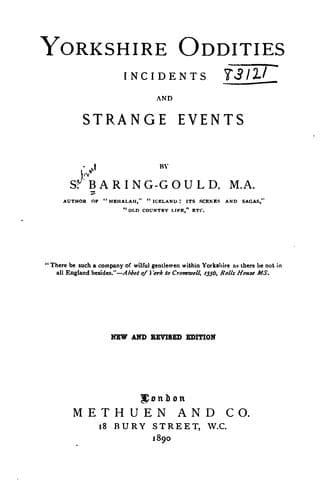
Yorkshire Oddities, Incidents, and Strange EventsBaring-Gould, S. (Sabine)
History
Yorkshire Oddities, Incidents, and Strange Events
Baring-Gould, S. (Sabine)
Legends -- England -- Yorkshire; Yorkshire (England) -- Miscellanea
For a considerable time during our walk from Malham Tarn to Settle I had
been silent. Keene could endure it no longer, and at last exclaimed,
"Really this is intolerable! You have been in a brown study for the last
half-hour without speaking a word. A penny for your thoughts!"
"To tell you the truth," I replied, "I have been thinking over what
might have happened if you had fallen lame at Arncliffe, _if_ I had gone
on a geological walk without you, and had lost my way on Penigent, and
had fallen in with a Boggart, who tried to precipitate me down a pot,
and if I had been rescued by an _ignus fatuus_, and had finally
descended the pot and brought up the Boggart's bones!"
Mr. Keene stared at me with amazement. I then related to him what I have
just related to you, good reader, and I concluded with the observation:
"All this, you know, _might_ have happened, but unfortunately it
_didn't_. You have had my thoughts, so hand me your penny."
FOOTNOTE:
[23] Contributed by me to _Once a Week_, March, 1867.
JONATHAN MARTIN,
THE INCENDIARY OF YORK MINSTER.[24]
Jonathan Martin was not a native of Yorkshire, but as it was in
Yorkshire that he lived part of his time, and as his name is inseparably
connected with the glorious Minster at York, which he partially burnt,
he claims our notice in this volume.
He was born, according to his own account, at Hexham, in Northumberland,
in 1782, of poor but honest parents, and by them, at a suitable age, was
put apprentice to a tanner. He appears to have served his apprenticeship
with steadiness, and on its expiration, when he was in his twenty-second
year, he removed to London, intending to travel. Soon after his arrival
in the metropolis, as he was one day viewing the Monument, a man
accosted him, and inquired if he wanted a situation. Martin told him he
wished to go abroad, on which the man replied that he could suit him
exactly, as a gentleman of his acquaintance had a son on board a frigate
on the Indian station, who wanted a person of Martin's description, and
would give him thirty-two shillings per month, besides his chance of
prize-money.
Martin eagerly accepted this offer. But he soon found that he was in
the hands of a press-gang; and he was sent to the Nore, where he was
placed on board the Hercules, 74 guns, which formed a part of the
expedition against Copenhagen in 1804 under Lord Nelson. After the
surrender of the Danish fleet he was drafted into one of the prizes, an
84-gun ship, which, with a squadron of seven other vessels, was ordered
to proceed to Lisbon to blockade the Russian fleet in the Tagus, in
order to prevent it from falling into the hands of the French. These
ships were taken by the British, and were brought to England.
The next affair Martin mentions in his biography as having been engaged
in was in assisting to bring off the troops from Corunna in January,
1809. He says, setting sail from Vigo Bay--
Public-domain text, read in full here on John Shaqi.
Reviews
Reviews
No reviews yet
Be the first to share your thoughts on this work.
Elsewhere in the archive
Join the Discussion
Join the discussion
Sign in to leave a comment or review.
Sign InorCreate an account