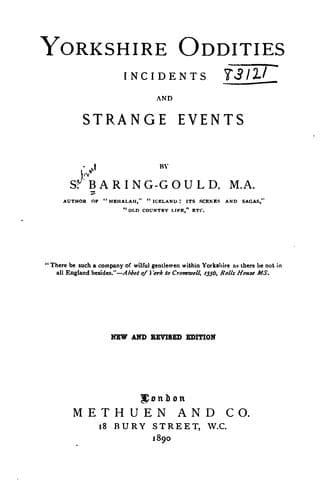
Yorkshire Oddities, Incidents, and Strange EventsBaring-Gould, S. (Sabine)
History
Yorkshire Oddities, Incidents, and Strange Events
Baring-Gould, S. (Sabine)
Legends -- England -- Yorkshire; Yorkshire (England) -- Miscellanea
"I had not for a long time seen my wife and child, as during the time I
was so rigorously confined they had been denied admittance. My poor wife
had long been labouring under heavy affliction, having a cancer in her
breast When I began to work they were allowed to come and see me, and my
wife at parting said--'Farewell, Jonathan, look to Jesus; pray for me;
may God bless you; my strength is fast failing, and I feel that I shall
not be able to come any more.' She spoke prophetically, for we met no
more. A short time after, she took to her bed, from which she never
rose. My readers may judge of my grief to think that my poor wife was
a-dying, at no great distance, and when she requested to see me, even in
custody and in chains, the keeper was so unfeeling as to refuse her
dying request. She afterwards sent my son (little more than seven years
old), hoping that his youth, innocence, and distress might soften their
hearts, but his appeal was unheeded. She sent him again with her dying
love to me, and the keeper's wife shut the door in his face, and the
child was suffered to return weeping to his mother. His supplication, as
I afterwards heard, would have melted any heart, crying, 'What will
become of me? My mother is dying, and my father is shut up in a
mad-house, where I am not so much as allowed to see him.'"
It must be remembered that Martin's account of things is not to be
trusted in all particulars. At the same time it is certain that asylums
were not conducted at that period with humanity and judgment.
Mrs. Orton, the keeper's wife alluded to, was examined at the trial of
Martin, ten years later. She said: "When Martin was with me I thought
him a really insane person. He would sit on the floor with two
cross-sticks as if he was fiddling, either singing hymns or whistling.
He called his sticks an imitation of David's harp. I have known him fast
four days--and say it was God Almighty's orders--in imitation of Christ
fasting forty days on the Mount. He was often under restraint, and was
bad to manage."
He succeeded in making his escape from the asylum[28] on the 17th of
June, 1820, but was caught at Norton and brought back. On the 1st of
July, 1820, he made his escape again by rubbing the rivets of his irons
with freestone, which he managed to secrete in his room. He broke
through the ceiling, got into a garret, and escaped through the tiles
upon the roof. He thence descended cautiously and safely to the ground;
and thus ended his captivity of three years.
Public-domain text, read in full here on John Shaqi.
Reviews
Reviews
No reviews yet
Be the first to share your thoughts on this work.
Elsewhere in the archive
Join the Discussion
Join the discussion
Sign in to leave a comment or review.
Sign InorCreate an account