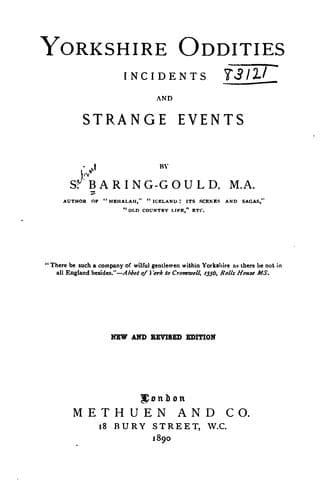
Yorkshire Oddities, Incidents, and Strange EventsBaring-Gould, S. (Sabine)
History
Yorkshire Oddities, Incidents, and Strange Events
Baring-Gould, S. (Sabine)
Legends -- England -- Yorkshire; Yorkshire (England) -- Miscellanea
The incendiary had left the Minster several hours before the fire was
discovered. The patrol left the Minster-yard about half-past two
o'clock, before he had made his escape, and they saw no indications of
anything unusual when they left. About four o'clock a man going past saw
a light in the Minster, but he thought the workmen were preparing a
vault, and unfortunately passed on without endeavouring to ascertain
what was really the cause of so unusual an occurrence as a light burning
in the sacred edifice at that early hour.
At five o'clock a series of reports, resembling repeated explosions,
were heard. The parties who heard them wondered what they meant, but
never thought of tracing them to their source. The discovery at last
took place in the following singular manner:--A lad named Swinbank, one
of the younger choristers, whose duty it was to go and practise at the
Minster early every morning, went as usual a little before seven o'clock
on the morning of the 2nd of February. He found the doors were not open,
and began to slide on a piece of ice in the Minster-yard to amuse
himself. Whilst so doing he fell on his back, and before he recovered
himself from that position he saw smoke issuing from the roof of the
Minster. Alarmed at the sight, he went to Job Knowles, the sexton, for
the keys. On his return he found the doors had been opened by some of
the workmen, and Mr. Scott, the builder, entered the building at the
south door, but had scarcely got in when he was compelled to retreat--so
dense was the smoke that respiration was impossible. A gentleman with
difficulty then made his way to the organ screen; but was compelled to
retreat to avoid suffocation. By the vestry-door, however, access was
obtained to the choir--the gates from the vestry, and also those leading
from the aisle into the choir, being fortunately open. The fire, which
originated at one end of the stalls, had consumed the whole row, with
all their tabernacle work; and about half-an-hour after it was first
discovered, the flames had spread to the stalls on the other side. One
of the Minster engines was kept in the vestry, and this was immediately
placed in the aisle, where it played on the place where the
communion-plate was kept, and around which the flames were raging with
great intensity: the tabernacle screen was in this spot burnt to the
ground, and the plate was melted into one mass. As soon as this engine
was got to work, several individuals succeeded in carrying out the whole
of the cushions and books from the north side of the choir; the cushions
and part of the hangings of the Cathedral were also saved, as was the
curious old chair which stood within the rails. The next effort was to
remove the brass eagle or lectern. This was effected with great
difficulty, owing to its weight, by the few persons who had the courage
to brave the suffocating effects of the smoke. They were driven back
three times before they succeeded in carrying off the upper part of the
Public-domain text, read in full here on John Shaqi.
Reviews
Reviews
No reviews yet
Be the first to share your thoughts on this work.
Elsewhere in the archive
Join the Discussion
Join the discussion
Sign in to leave a comment or review.
Sign InorCreate an account