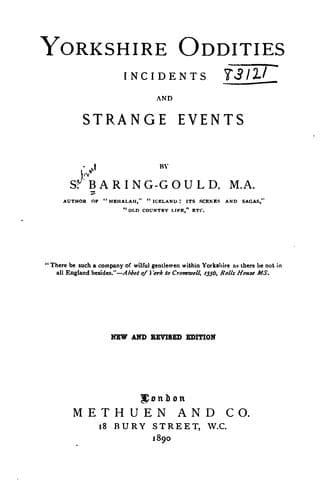
Yorkshire Oddities, Incidents, and Strange EventsBaring-Gould, S. (Sabine)
History
Yorkshire Oddities, Incidents, and Strange Events
Baring-Gould, S. (Sabine)
Legends -- England -- Yorkshire; Yorkshire (England) -- Miscellanea
It is impossible to conclude this part of the subject without alluding
to the remarkable circumstance that one of the lessons appointed to be
read on the Sunday after this calamity at the evening service was the
64th chapter of Isaiah, being the Church's prayer to God. It was
singularly applicable to the fire which destroyed the Cathedral; one
verse especially--"Our holy and our beautiful house, where our fathers
praised Thee, is burned with fire: and all our pleasant things are laid
waste." Few in the congregations assembled in the numerous churches of
York on the Sunday evening heard it unmoved. Another thing, thought to
be a coincidence, but which is certainly a very remote one, was that the
Cathedral was fired by Martin on Candlemas Day, using one of the
wax-candles employed in the choir during evensong.
Various reports as to the origin of the fire circulated in York. Some
supposed it originated from the gas, others attributed it to the candles
left alight in the organ loft or in the vestry of the clergy. But others
suspected it was the work of an incendiary, and they were confirmed in
this belief by finding the knotted rope which had been left by Martin,
and was discovered early in the morning.
On Monday evening a committee of inquiry was formed, consisting of
clergy and gentlemen. They met at the Residence; and the vergers,
workmen, and other individuals connected with the Minster, underwent a
rigorous examination. The investigation was continued on Tuesday and
Wednesday, and the strictest secrecy was observed in the proceedings; in
the course of which it was ascertained that the rope was cut from the
one which is attached to the prayer-bell, and that not with a knife, but
by being chafed with a sharp stone. It was also ascertained that the
window was opened from the interior; and a bunch of matches, burnt at
both ends, was found among the rubbish, and afterwards a pair of
shoemaker's pincers. The matches were found under the rubbish of the
burnt organ; the pincers on the stool of the window out of which the
knotted rope was suspended. The fact was also proved that several
anonymous letters had been sent to the vergers; and also that the
parcel, with the letter and pamphlet before alluded to, had been found
in the Minster by a person from Hull. A gentleman was despatched to Hull
to obtain possession of these documents; but in the meantime they had
fallen into the hands of Mr. Isaac Wilson, of that place, who with great
promptitude came to York and laid them before the committee.
Public-domain text, read in full here on John Shaqi.
Reviews
Reviews
No reviews yet
Be the first to share your thoughts on this work.
Elsewhere in the archive
Join the Discussion
Join the discussion
Sign in to leave a comment or review.
Sign InorCreate an account