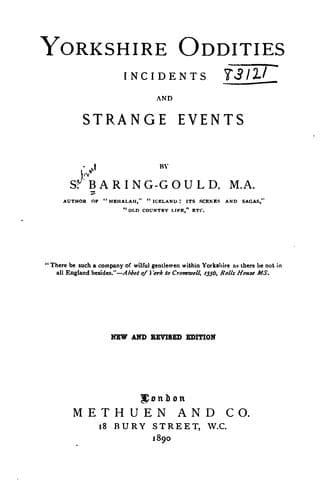
Yorkshire Oddities, Incidents, and Strange EventsBaring-Gould, S. (Sabine)
History
Yorkshire Oddities, Incidents, and Strange Events
Baring-Gould, S. (Sabine)
Legends -- England -- Yorkshire; Yorkshire (England) -- Miscellanea
It was a miracle--there could be no doubt of it. Eager hands tore down
the wall, and revealed the reverend brother, hale and rosy as of yore,
and at his side a loaf as fresh as when put in, and a pitcher still full
to the brim.
There could be no doubt but that this was a special interposition to
establish the innocence of the monk, and to indicate to the community
who was to be their future Prior.
With one voice they shouted, "Jucundus our Prior! Saint Jucundus our
head and father!"
On the shoulders of the enthusiastic brethren the miraculous monk was
carried up-stairs and installed in the Prior's seat in the
chapter-house.
Under him St. Leonard's jogged along very pleasantly, and he did much in
his long rule of the monastery for its discipline and good order, if not
to justify, at least to excuse the dissolution which fell on it
immediately after his death.
MARY BATEMAN,
WITCH AND MURDERESS.
Mary Harker was the daughter of a small farmer at Aisenby, in the parish
of Topcliffe, near Thirsk, where she was born in 1768. From an early age
she exhibited great quickness, which, instead of taking a direct course
and developing into intelligence, was warped into low cunning.
She received, for one in her situation, a good education--was taught to
read, and write, and cypher. But she very early showed a want of moral
principle, very possibly because it was never instilled into her by her
parents, and her first petty thefts having been pardoned or laughed at,
she grew bolder, and what had been occasional grew to be frequent, and
matured into a habit of peculation. Her father sent her into service at
the age of thirteen, in Thirsk, and for a while she either concealed or
did not yield to her propensity for theft. At all events, if she did
pilfer, she was neither suspected nor discovered.
At the age of twenty she left Thirsk for York, and after a year's
sojourn in that city, was detected in an attempt at robbery, and ran
away to Leeds, where, in 1788, she worked as a mantua-maker; but as her
knowledge of dressmaking was imperfect--she had only acquired it during
her twelvemonth at York, where her mistress had been a dressmaker--she
was able to work for the lower classes alone. She lived in Leeds for
four years, following this occupation and occasionally telling fortunes.
Her professed calling admirably served to introduce dupes to her, and
the servant-girls for whom she worked not infrequently introduced her to
their young mistresses.
In the year 1792 she married an honest, hard-working man named John
Bateman, who had made her acquaintance only three weeks previously. This
man, there is no reason for believing, was, at first at all events, an
accomplice in, or acquainted with, the crimes committed subsequently by
his wife, though afterwards it is scarcely possible to exculpate him
from connivance in them.
Public-domain text, read in full here on John Shaqi.
Reviews
Reviews
No reviews yet
Be the first to share your thoughts on this work.
Elsewhere in the archive
Join the Discussion
Join the discussion
Sign in to leave a comment or review.
Sign InorCreate an account