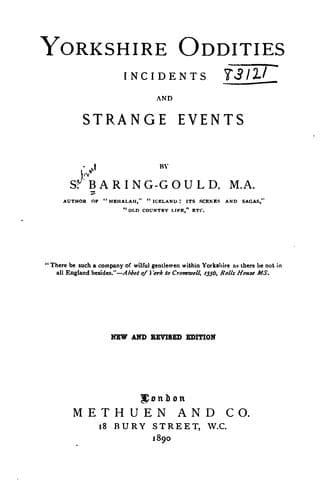
Yorkshire Oddities, Incidents, and Strange EventsBaring-Gould, S. (Sabine)
History
Yorkshire Oddities, Incidents, and Strange Events
Baring-Gould, S. (Sabine)
Legends -- England -- Yorkshire; Yorkshire (England) -- Miscellanea
The witch also contrived to ingratiate herself into the good opinion of
another young woman, and got from her several sums of money for the
purpose of curing her of an "evil wish" laid upon her by an old
beggar-woman whom she had refused to relieve. The cure was to be
effected by Miss Blythe, to whom a pocket-handkerchief was to be sent.
In due course the directions arrived, and Miss Blythe, who, like Mrs.
Moore, could never put her charms in motion without money, required that
different sums, amounting in all to five guineas, should be produced,
and as much wearing apparel as was worth about the same sum; but this
money and these clothes were only to be kept till the evil wish was
removed, and then to be restored to the owner. The period fixed for the
opening of the mysterious bags, in which these articles were deposited,
had arrived, when one day a person brought a fruit-pie to the young
woman, telling her that her sweetheart had sent it. This pie she tasted,
and let a fellow-servant partake with her, but though very nice in
appearance, the taste was hot and offensive; they in consequence
desisted from eating it, and the young woman took it down to Mary
Bateman to ask her opinion. Mary affected that she knew nothing herself
of such things, but she would send it to the sagacious Miss Blythe.
This, as the simple girl supposed, was done, and Miss Blythe informed
her that it was very well she had not eaten much of the pie, for if she
had, it would have been her last, as it was "full of poison!" Soon after
the girl opened the bags, and found that her guineas had turned to
copper and her clothes to old rags!
In the year 1807, Bateman, who, owing to the conduct of Mary, never
remained long in one place, removed into Meadow Lane. While living in
this situation a very extraordinary circumstance occurred, and it is not
improbable that Mary was in some way privy to the transaction. A man of
the name of Joseph Gosling, a cloth-dresser, had been long out of
employ, and his family, which consisted of a wife and four children, was
reduced to great extremity. One day the whole of the family had been out
for some time, when one of the children, a boy about seven years of age,
returned, and found on the table a small cake; the mother and other
children soon after returned, and partook of this cake. They immediately
became so sick as to render medical aid necessary. Mr. Atkinson, the
surgeon, was then sent for, and by administering emetics saved the lives
of the family. On analysing the cake it was found to contain a large
quantity of arsenic. It is impossible to say why or by whom this
poisonous bread was placed in the situation in which the boy found it,
and the only reason why it is supposed to have been placed there by Mary
Bateman is the knowledge that poisonous drugs were much in use by her,
that human life was in her estimation of little value; and that the
cries or tricks of the children may have inconvenienced her.
Public-domain text, read in full here on John Shaqi.
Reviews
Reviews
No reviews yet
Be the first to share your thoughts on this work.
Elsewhere in the archive
Join the Discussion
Join the discussion
Sign in to leave a comment or review.
Sign InorCreate an account