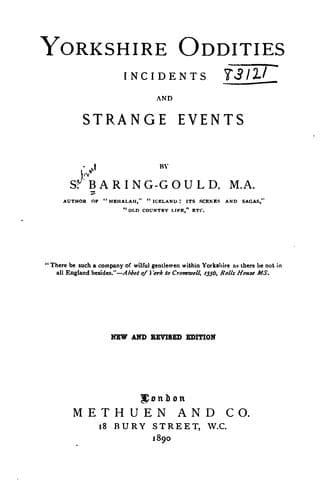
Yorkshire Oddities, Incidents, and Strange EventsBaring-Gould, S. (Sabine)
History
Yorkshire Oddities, Incidents, and Strange Events
Baring-Gould, S. (Sabine)
Legends -- England -- Yorkshire; Yorkshire (England) -- Miscellanea
Soon after this, witness was ordered by Mr. Chorley to Buxton, and
having on his return called on the poisoner, she expressed her surprise
that he should have gone to a doctor contrary to Miss Blythe's command,
and said that had she known he had been going to Buxton, she would have
given him a bottle that would have cured him on the road.
William Perigo proceeded to relate that on the 19th of October, 1808, he
unripped the bed in which all the bags were sewn up, and having opened
the whole of them, he found no money whatever. In the bags in which he
expected to find guinea-notes, he found only waste paper, and where he
expected to find gold, he found only a halfpenny or a farthing. But the
four silk bags in which he saw four guinea-notes put, he could not find
at all, nor could he give any account as to how or where they were gone.
Upon making this discovery the witness went to Leeds, and saw Mary
Bateman, and said to her, "I am sorry to think you should use me in this
manner;" to which she replied, "How?" He then said, "I have opened the
bags, and there is nothing in them but bits of lead, plain paper, bad
halfpennies, and bad farthings." At which she did not seem at all
surprised, but said, "You have opened them too soon." He answered, "I
think it is too late." He then said he would come down to her house in
the morning with two or three men and have things settled. The prisoner
begged that he would not, and said if he would appoint a time and place
to meet her alone, she would satisfy him. To this the witness consented,
and the Leeds and Liverpool canal bank, near the bridge, was fixed as
the place of meeting.
The officers of justice arrested Mary Bateman at this meeting.
The trial was conducted at York before Sir Simon Le Blanc on the 17th
March, 1809; she was found guilty, and condemned to death.
During the brief interval between her receiving the sentence of death
and her execution, the Rev. George Brown took great pains to prevail
upon her to acknowledge and confess her crime. On his touching upon the
subject of the Quaker ladies, whose death had been so sudden and
mysterious, she seemed perfectly to understand his meaning, but said
that she knew nothing about it, as at the time she was confined in
childbirth.
Public-domain text, read in full here on John Shaqi.
Reviews
Reviews
No reviews yet
Be the first to share your thoughts on this work.
Elsewhere in the archive
Join the Discussion
Join the discussion
Sign in to leave a comment or review.
Sign InorCreate an account