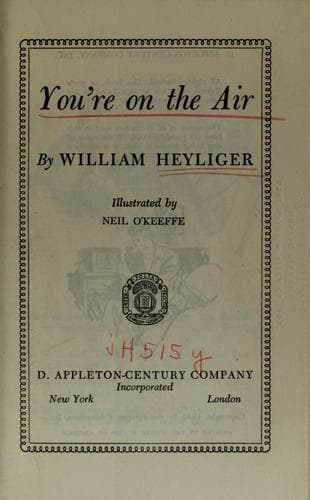
Dramatists -- Juvenile fiction; Radio acting -- Juvenile fiction; Radio broadcasting -- Juvenile fiction
The actor tapped a cigarette against the desk. “Stella gets two nights a
week as a waitress in an all-night restaurant. Lucille thought she was
all set to go into a night club as a cigarette girl. The club folded
up.” A match flamed and touched the cigarette. “I don’t have to do it,
Joe. I love funerals. Didn’t you know?”
In two sentences Archie had painted a picture. Once Joe would have said
lightly: “That’s show business.” Now he couldn’t be flippant. He knew it
_was_ show business—their show business. Rehearsals for hours, cutting
platters that probably never sold, perhaps playing a rôle in a
sustaining show day after day! And nobody paid you a dollar. Going
hungry, perhaps; washing out your single shirt, as Pop Bartell did, and
hanging it to dry while you slept. You dug up a job so that you could
eat, but it had to be a skimpy, part-time job that permitted you to keep
body and soul together, and you lavished that body and soul on radio.
You lived on a sustaining hope, a feverish, burning hope, that some day
all the mean, petty economies of small time would be behind you and
you’d know the glory of the fame of big time.
Joe said doggedly: “It won’t be that way with me.” In Wylie’s book, he
had top billing. If he was good enough for Wylie, he was good enough for
any of them. Time would do it. He had made the rounds to-day and had
found nothing. But to-morrow....
To-morrow became another yesterday, and then another yesterday. A week
passed. And still he had nothing. Once John Dennis said an automatic
“Have a good summer?” as though forgetting this was not his first visit.
That was the day the sway of Joe’s shoulders lost easy naturalness and
became front. The bread-and-butter tide had dwindled. Those no longer
making the rounds were working. Perhaps not getting any money, but at
least rehearsing and auditioning. Archie Munn had caught on with a
sponsored Sunday show. Soon the commercials would all be cast. After
that there would be only occasional bits in shows like _I Want Work_, or
the sustaining shows, originating in the studios, that paid only in
experience. And actors and actresses that the producers had thus far
discarded would still make the rounds, and smile a smile that was
becoming fixed and mechanical, and pray for a chance at even these
starvation crumbs.
In show business, Joe told himself, you had to get the breaks. The
breaks hadn’t yet come. They would. Either Wylie had judgment or he
hadn’t. The boy was sure he had. He believed in Wylie. And yet, to-day
when he reached the building that housed Vic Wylie Productions, he could
not go in. With the red-headed, dynamic producer present the office was
magnetized; with Wylie absent, the place was only four barren walls. He
couldn’t stand barrenness—too many other things were barren. Undecided,
he kept walking and approached his father’s store. He thought with
surprise, “I always seem to end up here when show business gets tough.”
Public-domain text, read in full here on John Shaqi.
Reviews
Reviews
No reviews yet
Be the first to share your thoughts on this work.
Elsewhere in the archive
Join the Discussion
Join the discussion
Sign in to leave a comment or review.
Sign InorCreate an account