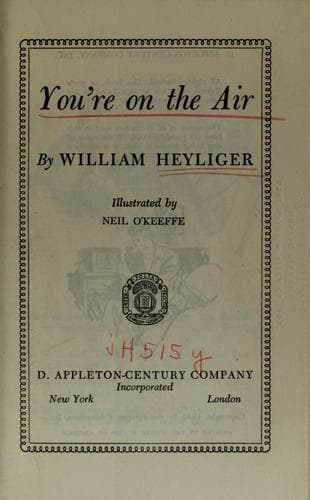
Dramatists -- Juvenile fiction; Radio acting -- Juvenile fiction; Radio broadcasting -- Juvenile fiction
Tom Carlin came home an hour earlier than usual. Coming down the stairs,
Joe heard low-voiced talk in the kitchen. Conversation died away with
his appearance.
“Didn’t the show seem to have more body to-day?” his father asked.
Evidently there was to be no telling him the show had been bad. He was
grateful for that. What good was family loyalty that blindly deceived
itself?
There was no talk of _Sue Davis_ at the evening meal. Tom Carlin felt
through his pockets.
“Care to walk to the corner, Joe? I’m out of tobacco.”
Joe thought: “He wants to talk to me alone.”
“You told Mother something would turn up,” his father said as soon as
they reached the street. “I’ve been trying to figure out if you really
meant that. Men usually try to shield the women at home from their
business worries. Was what happened to-day a situation that turns up
habitually in radio or was it serious?”
Joe did not hesitate. “It was serious.”
“Munson didn’t want you originally and has resented you. Is that what
you mean?”
Joe nodded.
“Do you think you’re out of the show permanently?”
“I don’t know. I might never have had the part if Sonny Baker had been
in town last month.” He had never before talked to his father so freely
and so easily, man to man, without restraint.
The owner of the neighborhood store greeted them. “Glad to hear you back
on the air, Joe. You acted good—better than I ever heard you before.
Nothing like a little vacation.”
“Nothing,” Tom Carlin said dryly.
Joe winced.
Walking home, Tom Carlin said: “That hurt, Joe, didn’t it? I was working
at your age in a country store for two dollars a week. There was another
merchant in town with a more imposing store, and I expected to go to
work for him the next month for two-fifty a week. In those days a great
many persons bought bean coffee and ground it at home. A customer came
in for a coffee-mill. I took a heavy mill down from the shelf and
dropped it. It smashed, and the handle flew up and knocked off the
customer’s hat. He left in a rage. My employer fired me. The other
merchant decided he didn’t want a clumsy lout for a clerk. I was out of
the job I was holding and out of the job I had expected to hold. I
thought it might help if I told you.”
It seemed incredible that the man who owned one of the brightest stores
in the city should have lost two jobs in one day. Two jobs—two parts.
“It does help,” Joe said.
Suddenly he knew that to-morrow he’d go downtown. Downtown was his world
with or without a voice, with or without a part. But he wouldn’t go
downtown with a swaggering, theatrical front. Front was a fake.
Public-domain text, read in full here on John Shaqi.
Reviews
Reviews
No reviews yet
Be the first to share your thoughts on this work.
Elsewhere in the archive
Join the Discussion
Join the discussion
Sign in to leave a comment or review.
Sign InorCreate an account