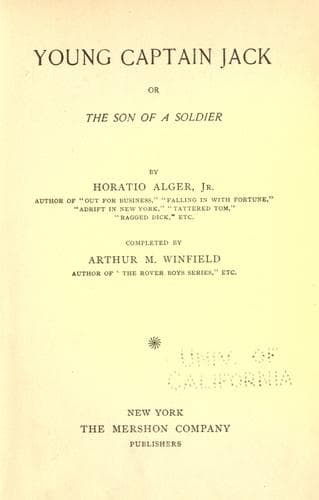
Young Captain Jack; Or, The Son of a SoldierAlger, Horatio, Jr.
History
Young Captain Jack; Or, The Son of a Soldier
Alger, Horatio, Jr.
United States -- History -- Civil War, 1861-1865 -- Juvenile fiction
"Then you had better do it," answered Mrs. Ruthven, with, however, but
little sympathy in her voice.
"I will go to bed at once."
"You must not forget that your cousin, Harry Powell, is in the army."
"Yes, on the Yankee side."
"Still he is brave enough to go. Marion may think a good deal of him on
that account."
"Well, I would go, for Marion's sake, if I felt at all well," groaned
St. John. "But I am in for a regular spell of sickness, I feel certain
of it."
"Then go to bed."
"Write Colonel Raymond a note stating that I am in bed, and tell him I
would join the ranks if I possibly could," groaned St. John, and then
dragged himself upstairs and retired. Here he called for a negro servant
and had a man go for a doctor.
Much disgusted, Mrs. Mary Ruthven penned the note, and sent it to town,
shielding her son's true character as much as possible.
For the remainder of the day St. John stayed in bed, and whenever a
servant came into his room he would groan dismally.
When the doctor arrived he was alarmed, until he made an examination.
"He is shamming," thought the family physician. But as the Ruthvens were
among his best customers, he said nothing on this point. He left St.
John some soothing medicine and a tonic, and said he would call again
the next day.
Instead of using the medicine, the young spendthrift threw it out of the
window.
"Don't catch me swallowing that stuff," he chuckled to himself. "I am
not altogether such a fool."
Several days passed, and nothing of importance happened to disturb those
at either of the Ruthven plantations.
But a surprise was in store for Jack and those with whom he lived.
One of the wounded soldiers stopping at Mrs. Alice Ruthven's home was
named George Walden. The poor fellow had been shot in the shoulder, a
painful as well as a dangerous wound.
For several days he lay speechless, and during that time the Confederate
surgeon and Mrs. Ruthven, as well as Marion, did all they could to ease
his suffering.
One day George Walden began to speak to Marion.
"You are very good to me," he said. "You are in reality an angel of
mercy."
"I am glad to be able to help you, and thus help the Southern cause,"
replied Marion. "But you must not speak too much. It may retard your
recovery."
"I will not talk much. But you are so kind I must thank you. What is
your name?"
"Marion Ruthven."
Then he told her his own, and said he had a sister at home, in Savannah,
Ga., and asked Marion to write a letter for him, which she did
willingly.
After that Marion and George Walden became quite intimate, and the
soldier told much about himself and the battles through which he had
passed.
"Some of them are nothing but nightmares," he said. "I never wish to see
the like of them again."
"And yet you saw only the fighting, I presume," said Marion. "Think of
what those in the hospital corps must behold."
"I was attached to the hospital corps," returned George Walden. "I have
helped to carry in hundreds who were wounded."
Public-domain text, read in full here on John Shaqi.
Reviews
Reviews
No reviews yet
Be the first to share your thoughts on this work.
Elsewhere in the archive
Join the Discussion
Join the discussion
Sign in to leave a comment or review.
Sign InorCreate an account