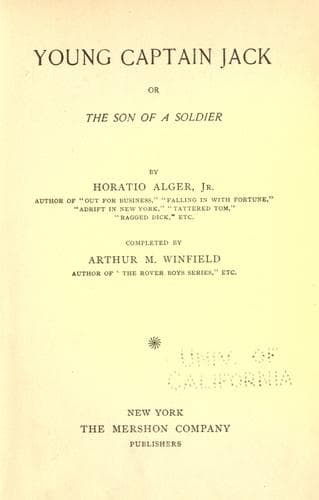
Young Captain Jack; Or, The Son of a SoldierAlger, Horatio, Jr.
History
Young Captain Jack; Or, The Son of a Soldier
Alger, Horatio, Jr.
United States -- History -- Civil War, 1861-1865 -- Juvenile fiction
"Then you haven't seen or heard of Jack," said Mrs. Ruthven. "He has
been missing since last night."
"No, I haven't seen him--and I don't want to see him. He insulted me and
made trouble between me and my mother."
"On account of the fire?"
"Yes. He thinks he is a regular lord of creation, he does," went on St.
John hotly. "He wants dressing down, Aunt Alice."
"I cannot believe Jack has done anything very wrong."
"He is a nobody, and puts on altogether too many airs."
Mrs. Ruthven would not listen to this talk, and changed the subject by
asking him what had brought him over from his home.
"I was asked to come over and see if you had any of the Yankee wounded
here."
"Who sent you?"
"Colonel Bromley of our army."
"No, we have only Confederates here."
"How many?"
"Five. Four of them are doing very well, you can tell the colonel, but
the fifth was hurt when our house was struck by a cannon ball, and he is
now in a high fever."
"All right, I'll tell him."
"Have you joined the army at last?" questioned Marion curiously.
"Not exactly, but I told the colonel I would help him in any manner that
I could," answered St. John, and hurried away for fear of being
questioned further.
The truth of the matter was that the fire had brought on a bitter
quarrel between St. John and his mother, and the parent had insisted
that the son overcome his cowardice and do something for his country.
St. John had demurred in vain, and had at last gone to the Confederate
headquarters and offered his services; but as a civilian, not as a
soldier.
When the young man was gone Mrs. Ruthven and Marion had Old Ben and the
others make another search for Jack, and this hunt lasted far into the
night.
But it was of no avail; our hero had disappeared as utterly as if the
earth had opened and swallowed him.
"Mamma, do you think it possible that the Yankees captured him?" was the
question Marion put.
"Not unless Jack left home during the night, Marion. And what would
cause him to leave without telling us that he was going?"
"That is true. Jack wouldn't do anything to cause us anxiety."
"It is a great mystery," sighed Mrs. Ruthven.
Later a negro, living on the mountain side, came down to the plantation
and asked to see the lady of the house.
"I was t'inkin' yo' would be wantin' ter know wot became o' Master
Jack," said the colored man, who rejoiced in the name of Columbus
Washington.
"What do you know of him?" asked Mrs. Ruthven quickly.
"I seed him early dis mornin', missus--away up in the mountains."
"The mountains? Alone?"
"No, missus--he was a prisoner."
"Of the Yankees?"
"De men wot had him was dressed as Confed'rates, missus."
"You did not know them?"
"No, missus."
"And you are certain that Jack was held a prisoner?"
"Oh. yes, missus, fo' one ob de men said he would shoot if de boy tried
to git away from him."
Mrs. Ruthven clasped her hands in despair.
"A prisoner! Did you speak to him?"
Public-domain text, read in full here on John Shaqi.
Reviews
Reviews
No reviews yet
Be the first to share your thoughts on this work.
Elsewhere in the archive
Join the Discussion
Join the discussion
Sign in to leave a comment or review.
Sign InorCreate an account