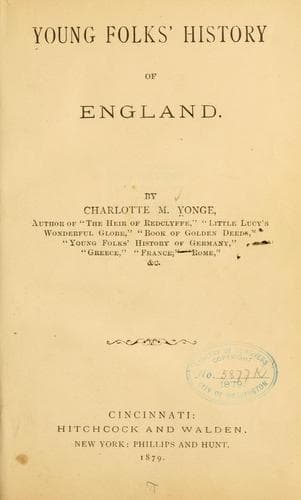
Young Folks' History of EnglandYonge, Charlotte M. (Charlotte Mary)
History
Young Folks' History of England
Yonge, Charlotte M. (Charlotte Mary)
Great Britain -- History -- Juvenile literature
Neither the English nor the French could bear that the Russians should
get so much power as they would have, if they gained all the countries
down to the Mediterranean Sea; so, as soon as ever the Russians began
to attack the Turks, the English and French armies were sent to defend
them; and they found the best way of doing this was to go and fight
the Russians in their own country, namely--the Crimea, the peninsula
which hangs as it were, down into the Black Sea. So, in the autumn of
the year 1854, the English and French armies, under Lord Raglan and
Marshal St. Arnaud, were landed in the Crimea, where they gained a
great victory on their first landing, called the battle of the Alma,
and then besieged the city of Sebastopol. It was a very long siege,
and in the course of it the two armies suffered sadly from the cold
and damp, and there was much illness; but a brave English Lady, named
Florence Nightingale, went out with a number of nurses to take care of
the sick and wounded, and thus she saved a great many lives. There
were two more famous battles. One was when six hundred English
horsemen were sent by mistake against a whole battery of Russian
cannon, and rode on as bravely as if they were not seeing their
comrades shot down, till scarcely half were left. This was called
the Charge of Balaklava. The other battle was when the Russians
crept out, late in the evening of November 5, to attack the English
camp: and there was a dreadful fight by night and in the early morning
on the heights of Inkerman; but at last the English won the battle,
and gave the day a better honor that it had had before. Then came a
terrible winter of watching the city and firing at the walls; and when
at last, on the 18th of June, 1855, it was assaulted, the defenders
beat the attack off; and Lord Raglan, worn out with care and vexation,
died a few days after. However, soon another attack was made, and
in September half the city was won. The Emperor of Russia had died
during the war, and his son made peace, on condition that Sebastopol
should not be fortified again, and that the Russians should let the
Turks alone, and keep no fleet in the Black Sea.
In this war news flew faster than ever it had done before. You heard
how Benjamin Franklin found that electricity--that strange power of
which lightning is the visible sign--could be carried along upon metal
wire. It has since been made out how to make the touch of a magnet
at one end of these wires make the other end move so that letters can
be pointed to, words spelt out and messages sent to any distance with
really the speed of lightning. This is the wonderful electric
telegraph, of which you see the wires upon the railway.
CHAPTER XLIX.
VICTORIA. A.D. 1857--1860.
Public-domain text, read in full here on John Shaqi.
Reviews
Reviews
No reviews yet
Be the first to share your thoughts on this work.
Elsewhere in the archive
Join the Discussion
Join the discussion
Sign in to leave a comment or review.
Sign InorCreate an account