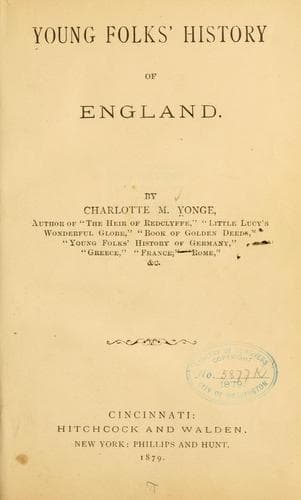
Young Folks' History of EnglandYonge, Charlotte M. (Charlotte Mary)
History
Young Folks' History of England
Yonge, Charlotte M. (Charlotte Mary)
Great Britain -- History -- Juvenile literature
The English regiments in India made haste to come into Bengal, to try
to save their country-folk who had shut themselves up in the towns or
strong places, and were being besieged there by the Sepoys. A great
many were in barracks in Cawnpore. It was not a strong place, and
only had a mud wall round; but there was a native prince called the
Nana Sahib, who had always seemed a friend to the officers--had gone
out hunting with them, and invited them to his house. They thought
themselves safe near him; but, to their horror, he forgot all this,
and joined the Sepoys. The cannon were turned against them, and the
Sepoys watched all day the barrack yard where they were shut in, and
shot everyone who went for water. At last, after more pain and misery
than we can bear to think of, they gave themselves up to the Nana, and
horrible to tell, he killed them all. The men were shot the first day,
and the women and little children were then shut up in a house, where
they were kept for a night. Then the Nana heard that the English army
was coming, and in his fright and rage he sent in his men, who killed
everyone of them, and threw their bodies into a deep well. The English
came up the next day, and were nearly mad with grief and anger. They
could not lay hands on the Nana, but they punished all the people he
employed; and they were so furious that they hardly showed any mercy
to another Sepoy after that dreadful sight.
There were some more English holding out in the city of Lucknow, and
they longed to go to their relief; but first Delhi, where the old king
was, had to be taken; and, as it was a very strong place, it was a
long time before it was conquered; but at last the gates of the city
were blown up by three brave men, and the whole army made their way
in. More troops had been sent out from England to help their comrades,
and they were able at last to march to Lucknow. There, week after
week, the English soldiers, men of business, ladies, soldier's wives,
and little children, had bravely waited, with the enemy round, and
shot so often coming through the buildings that they had chiefly to
live in the cellars; and the food was so scanty and bad, that the
sickly people and the little babies mostly died; and no one seemed
able to get well if once he was wounded. Help came at last. The
brave Sir Colin Campbell, who had been sent out from home, brought the
army to their rescue, and they were saved. The Sepoys were beaten in
every fight; and at last the terrible time of the mutiny was over, and
India quiet again.
Public-domain text, read in full here on John Shaqi.
Reviews
Reviews
No reviews yet
Be the first to share your thoughts on this work.
Elsewhere in the archive
Join the Discussion
Join the discussion
Sign in to leave a comment or review.
Sign InorCreate an account