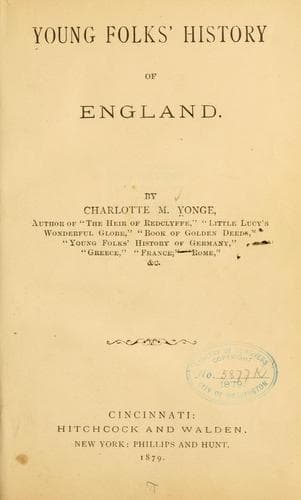
Young Folks' History of EnglandYonge, Charlotte M. (Charlotte Mary)
History
Young Folks' History of England
Yonge, Charlotte M. (Charlotte Mary)
Great Britain -- History -- Juvenile literature
As for the two boys, they were never seen out of the Tower again.
They were sent into the prison part of it, and nobody exactly knows
what became of them there; but there cannot be much doubt that they
must have been murdered. Some years later, two men confessed that
they had been employed to smother the two brothers with pillows, as
they slept; and though they added some particulars to the story that
can hardly be believed, it is most likely that this was true. Full
two hundred years later, a chest was found under a staircase, in
what is called the White Tower, containing bones that evidently had
belonged to boys of about fourteen and eleven years old; and these
were placed in a marble urn among the tombs of the kings in
Westminster Abbey. But even to this day, there are some people who
doubt whether Edward V. and Richard of York were really murdered, or
if Richard were not a person who came back to England and tried to
make himself king.
CHAPTER XXIV.
RICHARD III. A.D. 1483--1485.
Richard III. seems to have wished to be a good and great king; but he
had made his way to the throne in too evil a manner to be likely to
prosper. How many people he had put to death we do not know, for when
the English began to suspect the he had murdered his two nephews, they
also accused him of the death of everyone who had been secretly slain
ever since Edward IV. came to the throne, when he had been a mere boy.
He found he must be always on the watch; and his home was unhappy, for
his son, for whose sake he had striven so hard to be king, died while
yet a boy, and Anne, his wife, not long after.
Then his former staunch friend, the Duke of Buckingham, began to feel
that though he wanted the sons of Elizabeth Woodville to be set aside
from reigning, it was quite another thing to murder them. He was a
vain, proud man, who had a little royal blood--being descended from
Thomas, the first Duke of Gloucester, son of Edward III.--and he
bethought himself that, now all the House of Lancaster was gone, and
so many of the House of York, he might possibly become king. But he
had hardly begun to make a plot, before the keen-sighted, watchful
Richard found it out, and had him seized and beheaded.
There was another plot, though, that Richard did not find out in time.
The real House of Lancaster had ended when poor young Edward was
killed at Tewkesbury; but the Beauforts--the children of that younger
family of John of Gaunt, who had first begun the quarrel with the Duke
of York--were not all dead. Lady Margaret Beaufort, the daughter of
the eldest son, had married a Welsh gentleman named Edmund Tudor, and
had a son called Henry Tudor, Earl of Richmond. Edward IV. had always
feared that this youth might rise against him, and he had been obliged
to wander about in France and Brittany since the death of his father;
but nobody was afraid of Lady Margaret, and she had married a Yorkist
nobleman, Lord Stanley.
Public-domain text, read in full here on John Shaqi.
Reviews
Reviews
No reviews yet
Be the first to share your thoughts on this work.
Join the Discussion
Join the discussion
Sign in to leave a comment or review.
Sign InorCreate an account