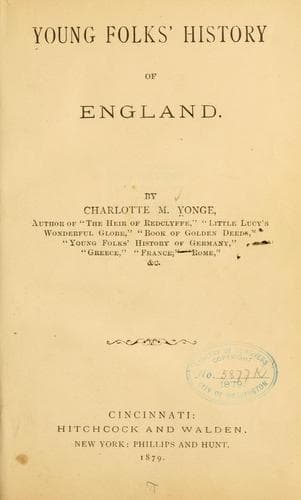
Young Folks' History of EnglandYonge, Charlotte M. (Charlotte Mary)
History
Young Folks' History of England
Yonge, Charlotte M. (Charlotte Mary)
Great Britain -- History -- Juvenile literature
Now, the eldest daughter of Edward IV.--Elizabeth, or Lady Bessee, as
she was called--was older than her poor young brothers; and she heard,
to her great horror, that her uncle wanted to commit the great
wickedness of making her his wife, after poor Anne Nevil's death.
There is a curious old set of verses, written by Lord Stanley's
squire, which says that Lady Bessee called Lord Stanley to a secret
room, and begged him to send to his stepson, Richmond, to invite him
to come to England and set them all free.
Stanley said he could not write well enough, and that he could not
trust a scribe; but Lady Bessee said she could write as well as any
scribe in England. So she told him to come to her chamber at nine
that evening, with his trusty squire; and there she wrote letters,
kneeling by the table, to all the noblemen likely to be discontented
with Richard, and appointing a place of meeting with Stanley; and she
promised herself that, if Henry Tudor would come and overthrow the
cruel tyrant Richard, she would marry him: and she sent him a ring
in pledge of her promise.
Henry was in Brittany when he received the letter. He kissed the
ring, but waited long before he made up his mind to try his fortune.
At last he sailed in a French ship, and landed at Milford Haven--for
he knew the Welsh would be delighted to see him; and, as he was really
descended from the great British chiefs, they seemed to think that
to make him king of England would be almost like having King Arthur
back again.
They gathered round him, and so did a great many English nobles and
gentlemen. But Richard, though very angry, was not much alarmed, for
he knew Henry Tudor had never seen a battle. He marched out to meet
him, and a terrible fight took place at Redmore Heath, near Market
Bosworth, where, after long and desperate struggling, Richard was
overwhelmed and slain, his banner taken, and his men either killed
or driven from the field. His body was found gashed, bleeding, and
stripped; and thus was thrown across a horse and carried into
Leicester, where he had slept the night before.
The crown he had worn over his helmet was picked up from the branches
of a hawthorn, and set on the head of Henry Tudor. Richard was the
last king of the Plantagenet family, who had ruled over England for
more than three hundred years. This battle of Bosworth likewise
finished the whole bloody war of the Red and White Roses.
CHAPTER XXV.
HENRY VII. A.D. 1485--1509.
Henry Tudor married the Lady Bessee as soon as he came to London, and
by this marriage the causes of the Red and white Roses were united;
so that he took for his badge a great rose--half red and half white.
You may see it carved all over the beautiful chapel that he built on
to Westminster Abbey to be buried in.
Public-domain text, read in full here on John Shaqi.
Reviews
Reviews
No reviews yet
Be the first to share your thoughts on this work.
Join the Discussion
Join the discussion
Sign in to leave a comment or review.
Sign InorCreate an account