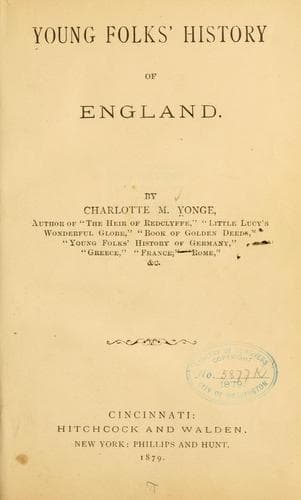
Young Folks' History of EnglandYonge, Charlotte M. (Charlotte Mary)
History
Young Folks' History of England
Yonge, Charlotte M. (Charlotte Mary)
Great Britain -- History -- Juvenile literature
He was not a very pleasant person; he was stiff, and cold, and dry,
and very mean and covetous in some ways--though he liked to make a
grand show, and dress all his court in cloth of gold and silver,
and the very horses in velvet housings, whenever there was any state
occasion. Nobody greatly cared for him; but the whole country was so
worn out with the troubles of the Wars of the Roses, that there was
no desire to interfere with him; and people only grumbled, and said
he did not treat his gentle, beautiful wife Elizabeth as he ought to
do, but was jealous of her being a king's daughter. There was one
person who did hate him most bitterly, and that was the Duchess of
Burgundy, the sister of Edward IV. and Richard III.: the same who,
as I told you, encouraged printing so much. She felt as if a mean
upstart had got into the place of her brothers, and his having
married her niece did not make it seem a bit the better to her.
There was one nephew left--the poor young orphan son of George, Duke
of Clarence--but he had always been quite silly, and Henry VII. had
him watched carefully, for fear some one should set him up to claim
the crown. He was called Earl of Warwick, as heir to his grandfather,
the king-maker.
Suddenly, a young man came to Ireland and pretended to be this Earl
of Warwick. He deceived a good many of the Irish, and the Mayor of
Dublin actually took him to St. Patrick's Cathedral, where he was
crowned as King Edward the Sixth: and then he was carried to the
banquet upon an Irish chieftain's back. He came to England with some
Irish followers, and some German soldiers hired by the duchess; and
a few, but not many, English joined him. Henry met him at a village
called Stoke, near Newark, and all his Germans and Irish were killed,
and he himself made prisoner. Then he confessed that he was really
a baker's son named Lambert Simnel; and, as he turned out to be a
poor weak lad, whom designing people had made to do just what they
pleased, the king took him into his kitchen as a scullion; and, as
he behaved well there, afterwards set him to look after the falcons,
that people used to keep to go out with to catch partridges and herons.
Public-domain text, read in full here on John Shaqi.
Reviews
Reviews
No reviews yet
Be the first to share your thoughts on this work.
Join the Discussion
Join the discussion
Sign in to leave a comment or review.
Sign InorCreate an account