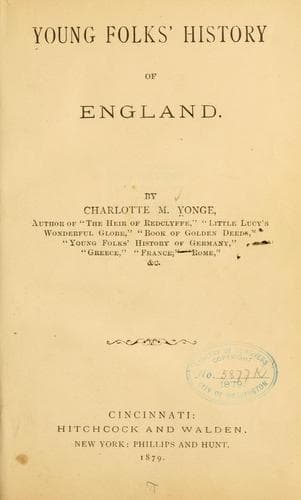
Young Folks' History of EnglandYonge, Charlotte M. (Charlotte Mary)
History
Young Folks' History of England
Yonge, Charlotte M. (Charlotte Mary)
Great Britain -- History -- Juvenile literature
But he forgave her,
and made her husband Duke of Suffolk.
Henry's chief adviser, at this time, was Thomas Wolsey, Archbishop
of York; a very able man, and of most splendid tastes and habits--
outdoing even the Tudors in love of show. The pope had made him a
cardinal--that is, one of the clergy, who are counted as parish
priests in the diocese of Rome, and therefore have a right to choose
the pope. They wear scarlet hats, capes, and shoes, and are the
highest rank of all the clergy except the pope. Indeed, Cardinal
Wolsey was in hopes of being chosen pope himself, and setting the
whole Church to rights--for there had been several very wicked men
reigning at Rome, one after the other, and they had brought things
to such a pass that everyone felt there would be some great judgment
from God if some improvement were not made. Most of Wolsey's
arrangements with foreign princes had this end in view. The new
king of France, Francis I., was young, brilliant and splendid, like
Henry, and the two had a conference near Calais, when they brought
their queens and their whole Court, and put up tents of velvet, silk,
and gold--while everything was so extraordinarily magnificent, that
the meeting has ever since been called the Field of the Cloth of Gold.
However, nothing came of it all. Cardinal Wolsey thought Francis's
enemy--the Emperor Charles V.--more likely to help him to be pope,
and make his master go over to that side; but after all an Italian
was chosen in his stead. And there came a new trouble in his way.
The king and queen had been married a good many years, and they had
only one child alive, and that was a girl, the Lady Mary--all the
others had died as soon as they were born--and statesmen began to
think that if there never was a son at all, there might be fresh wars
when Henry died; while others said that the loss of the children was
to punish them for marrying unlawfully. Wolsey himself began to wish
that the pope would say that it had never been a real marriage, and
so to set the king free to put Katharine away and take another wife--
some grand princess abroad. This was thinking more of what seemed
prudent than of the right; and it turned out ill for Wolsey and all
besides, for no sooner had the notion of setting aside poor Katharine
come into his mind, than the king cast his eyes on Anne Boleyn, one
of her maids of honor--a lively lady, who had been to France with his
sister Mary. He was bent on marrying her, and insisted on the pope's
giving sentence against Katharine. But the pope would not make any
answer at all; first, because he was enquiring, and then because he
could not well offend Katharine's nephew, the Emperor. Time went on,
and the king grew more impatient, and at last a clergyman, named
Thomas Cranmer, said that he might settle the matter by asking the
learned men at the universities whether it was lawful for a man to
marry his brother's widow. "He has got the right sow by the ear,"
Public-domain text, read in full here on John Shaqi.
Reviews
Reviews
No reviews yet
Be the first to share your thoughts on this work.
Elsewhere in the archive
Join the Discussion
Join the discussion
Sign in to leave a comment or review.
Sign InorCreate an account