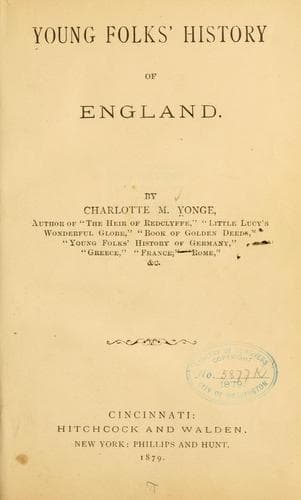
Young Folks' History of EnglandYonge, Charlotte M. (Charlotte Mary)
History
Young Folks' History of England
Yonge, Charlotte M. (Charlotte Mary)
Great Britain -- History -- Juvenile literature
cried Henry, who was not choice in his words, and he determined that
the universities should decide it. But Wolsey would not help the
king here. He knew that the pope had been the only person to decide
such questions all over the Western Church for many centuries; and,
besides, he had never intended to assist the king to lower himself by
taking a wife like Anne Boleyn. But his secretary, Thomas Crumwell,
told the king all of Wolsey's disapproval, and between them they found
out something that the cardinal had done by the king's own wish, but
which did not agree with the old disused laws. He was put down from
all his offices of state, and accused of treason against the king; but
while he was being brought to London to be tried, he became so ill at
the abbey at Leicester that he was forced to remain there, and in a
few days he died, saying, sadly--"If I had served God as I have served
my king, He would not have forsaken me in my old age."
With Cardinal Wolsey ended the first twenty years of Henry's reign,
and all that had ever been good in it.
CHAPTER XXVII.
HENRY VIII. AND HIS WIVES. A.D. 1528--1547.
When Henry VIII. had so ungratefully treated Cardinal Wolsey, there
was no one to keep him in order. He would have no more to do with the
pope, but said he was head of the Church of England himself, and could
settle matters his own way. He really was a very learned man, and had
written a book to uphold the doctrines of the Church, which had caused
the people to call him the Defender of the Faith. After the king's or
queen's name on an English coin you may see F.D.--_Fidei Defensor_.
This stands for that name in Latin. But Henry used his learning now
against the pope. He declared that his marriage with Katharine was
good for nothing, and sent her away to a house in Huntingdonshire,
where, in three years' time, she pined away and died. In the meantime,
he had married Anne Boleyn, taken Crumwell for his chief adviser, and
had made Thomas Cranmer archbishop of Canterbury. Then, calling
himself the head of the Church, he insisted that all his people should
own him as such; but the good ones knew that our Lord Jesus Christ is
the only real Head of the Church, and they had learnt to believe that
the pope is the father bishop of the west, though he had sometimes
taken more power than he ought, and no king could ever be the same
as a patriarch or father bishop. So they refused, and Henry cut off
the heads of two of the best--Bishop Fisher and Sir Thomas More--
though they had been his great friends. Sir Thomas More's good
daughter Margaret, came and kissed him on his way to be executed;
and afterwards, when his head was placed on a spike on London Bridge,
she came by night in a boat and took it home in her arms.
Public-domain text, read in full here on John Shaqi.
Reviews
Reviews
No reviews yet
Be the first to share your thoughts on this work.
Elsewhere in the archive
Join the Discussion
Join the discussion
Sign in to leave a comment or review.
Sign InorCreate an account