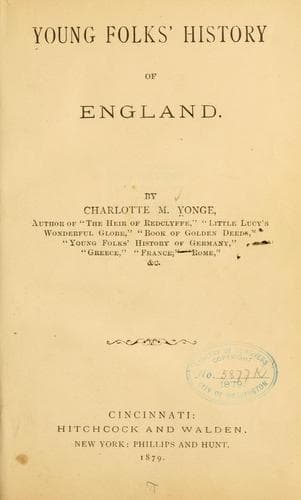
Young Folks' History of EnglandYonge, Charlotte M. (Charlotte Mary)
History
Young Folks' History of England
Yonge, Charlotte M. (Charlotte Mary)
Great Britain -- History -- Juvenile literature
The king at this time was sixteen. He had never been strong, and he
had learnt and worked much more than was good for him. He wrote a
journal, and though he never says he grieved for his uncles, most
likely he did, for he had few near him who really loved or cared for
him, and he was fast falling into decline, so that it became quite
plain that he was not likely ever to be a grown-up king. There was
a great difficulty as to who was to reign after him. The natural
person would have been his eldest sister, Mary, but King Henry had
forbidden her and Elizabeth to be spoken of as princesses or
heiresses of the crown; and, besides, Mary held so firmly to the
Church, as she had learnt to believe in it in her youth, that the
reformers knew she would undo all their work.
There was a little Scottish girl, also named Mary--the grand-daughter
of Margaret, eldest daughter of Henry VII. Poor child, she had been
a queen from babyhood, for her father had died of grief when she was
but a week old; and there had been some notion of marrying her to King
Edward, and so ending the wars, but the Scots did not like this, and
sent her away to be married to the Dauphin, Francois, eldest son of
the king of France. If Edward's sisters were not to reign, she came
next; but the English would not have borne to be joined on to the
French; and there were the grand-daughters of Mary, that other sister
of Henry VIII., who were thorough Englishwomen. Lady Jane Grey, the
eldest of them, was a good, sweet, pious, and diligent girl of fifteen,
wonderfully learned. But it was not for that reason, only for the
sake of the royal blood, that the Duke of Northumberland asked her
in marriage for his son, Guildford Dudley. When they were married,
the duke and Cranmer began to persuade the poor, sick, young king
that it was his duty to leave his crown away from his sister Mary
to Lady Jane, who would go on with the Reformation, while Mary would
try to overthrow it. In truth, young Edward had not right to will
away the crown; but he was only sixteen, and could only trust to
what the archbishop and his council told him. So he signed the
parchment they brought him, and after that he quickly grew worse.
The people grew afraid that Northumberland was shutting him up and
misusing him, and once he came to the window of his palace and looked
out at them, to show he was alive; but he died only a fortnight later,
and we cannot guess what he would have been when he was grown up.
CHAPTER XXIX.
MARY I. A.D. 1553--1588.
The Duke of Northumberland kept king Edward's death a secret till he
had proclaimed Jane queen of England. The poor girl knew that a great
wrong was being done in her name. She wept bitterly, and begged that
she might not be forced to accept the crown; but she could do nothing
to prevent it, when her father and husband, and his father, all were
bent on making her obey them; and so she had to sit as a queen in the
royal apartments in the Tower of London.
Public-domain text, read in full here on John Shaqi.
Reviews
Reviews
No reviews yet
Be the first to share your thoughts on this work.
Elsewhere in the archive
Join the Discussion
Join the discussion
Sign in to leave a comment or review.
Sign InorCreate an account