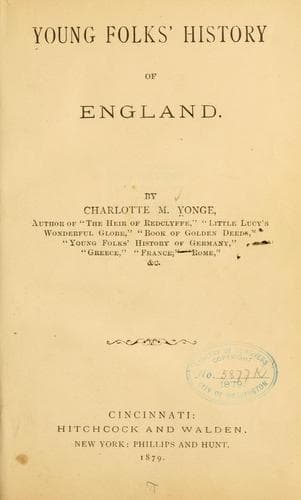
Young Folks' History of EnglandYonge, Charlotte M. (Charlotte Mary)
History
Young Folks' History of England
Yonge, Charlotte M. (Charlotte Mary)
Great Britain -- History -- Juvenile literature
The chief of the council were his two uncles--his mother's brothers,
Edward and Thomas Seymour, the elder of whom had been made Duke of
Somerset--together with Archbishop Cranmer; but it was not long before
the duke quarreled with his brother Thomas, put him into the Tower,
and cut off his head, so that it seemed as if the days of Henry VIII.
were not yet over.
The Duke of Somerset and Archbishop Cranmer wanted to make many more
changes in the Church of England than Henry VIII. had ever allowed.
They had all the Prayer-book Services translated into English, leaving
out such parts as they did not approve; The Lessons were read from the
English Bible, and people were greatly delighted at being able to
worship and to listen to God's Word in their own tongue. The first
day on which the English Prayer-book was used was the Whitsunday of
1548. The Bibles were chained to the desks as being so precious and
valuable; and crowds would stand, or sit, and listen for hours
together to any one who would read to them, without caring if he were
a clergyman or not; and men who tried to explain, without being
properly taught, often made great mistakes.
Indeed, in Germany and France a great deal of the same kind had been
going on for some time past, though not with any sort of leave from
the kings or bishops, as there was in England, and thus the reformers
there broke quite off from the Church, and fancied they could do
without bishops. This great break was called the Reformation, because
it professed to set matters of religion to rights; and in Germany the
reformers called themselves Protestants, because they protested some
of the teachings of the Church of Rome.
Cranmer had at one time been in Germany, and had made friends with
some of these German and Swiss Protestants, and he invited them to
England to consult and help him and his friends. Several of them
came, and they found fault with our old English Prayer-book--though
it had never been the same as the Roman one--and it was altered again
to please them and their friends, and brought out as King Edward's
second book. Indeed, they tried to persuade the English to be like
themselves--with very few services, no ornaments in the churches, and
no bishops; and things seemed to be tending more and more to what they
desired, for the king was too young not to do what his tutors and
governors wished, and his uncle and Cranmer were all on their side.
However, there was another great nobleman, the Duke of Northumberland,
who wanted to be as powerful as the Duke of Somerset. He was the son
of Dudley, the wicked judge under Henry VII., who had made himself so
rich, and he managed to take advantage of the people being discontented
with Somerset to get the king into his own hands, accuse Somerset of
treason, send him to the Tower, and cut off his head.
Public-domain text, read in full here on John Shaqi.
Reviews
Reviews
No reviews yet
Be the first to share your thoughts on this work.
Elsewhere in the archive
Join the Discussion
Join the discussion
Sign in to leave a comment or review.
Sign InorCreate an account