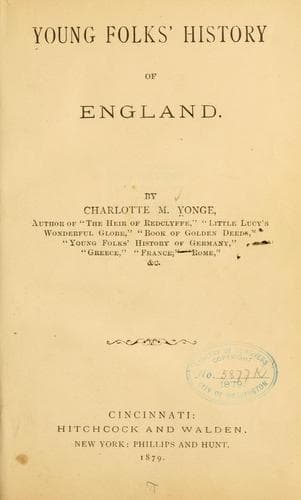
Young Folks' History of EnglandYonge, Charlotte M. (Charlotte Mary)
History
Young Folks' History of England
Yonge, Charlotte M. (Charlotte Mary)
Great Britain -- History -- Juvenile literature
Philip of Spain came and was married to Mary. She was very fond of
him, but he was not very kind to her, and he had too much to do in
his other kingdoms to spend much time with her, so that she was always
pining after him. Her great wish in choosing him was to be helped
in bringing the country back to the old obedience to the Pope; and
she succeeded in having the English Church reconciled, and received
again to communion with Rome. The new service she would under no
consideration have established in her house. This displeased many
of her subjects exceedingly. They thought they should be forbidden
to read the Bible--they could not endure the Latin service--and those
who had been taught by the foreigners fancied that all proper reverence
and beauty in church was a sort of idolatry. Some fled away into
Holland and Germany, and others, who staid, and taught loudly against
the doctrines that were to be brought back again, were seized and
thrown into prison.
Those bishops who had been foremost in the changes of course were the
first to be tried for their teaching. The punishment was the dreadful
one of being burnt alive, chained to a stake. Bishop Hooper died in
this way at Gloucester, and Bishop Ridley and Bishop Latimer were both
burnt at the same time at Oxford, encouraging one another to die
bravely as martyrs for the truth, as they held it. Cranmer was in
prison already for supporting Jane Grey, and he was condemned to
death; but he was led to expect that he would be spared the fire if
he would allow that the old faith, as Rome held it, was the right one.
Paper after paper was brought, such as would please the queen and his
judges, and he signed them all; but after all, it turned out that
none would do, and that he was to be burnt in spite of them. The he
felt what a base part he had acted, and was ashamed when he thought
how bravely his brethren had died on the same spot: and when he was
chained to the stake and the fire lighted, he held his right hand
over the flame to be burnt first, because it had signed what he did
not really believe, and he cried out, "This unworthy hand!"
Public-domain text, read in full here on John Shaqi.
Reviews
Reviews
No reviews yet
Be the first to share your thoughts on this work.
Elsewhere in the archive
Join the Discussion
Join the discussion
Sign in to leave a comment or review.
Sign InorCreate an account