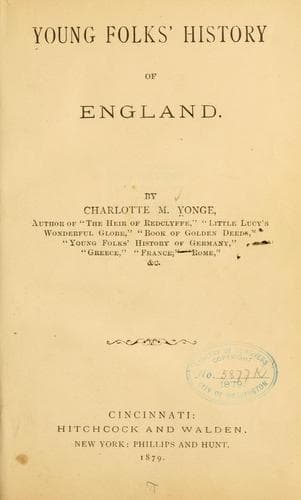
Young Folks' History of EnglandYonge, Charlotte M. (Charlotte Mary)
History
Young Folks' History of England
Yonge, Charlotte M. (Charlotte Mary)
Great Britain -- History -- Juvenile literature
King James was a fond of favorites as ever Elizabeth had been, though
not of the same persons. One of the worst things he ever did was the
keeping Sir Walter Raleigh in the Tower for many years, and a last
cutting off his head. It was asserted that Sir Walter had tried, when
first James came, to set up a lady named Arabella Stuart to be queen;
but if he was to be punished for that, it ought to have been directly,
instead of keeping the sentence hanging over his head for years. The
truth was that Sir Walter had been a great enemy to the Spaniards, and
James wanted to please them, for he wished his son Charles to marry the
daughter of the King of Spain. Charles wanted to see her first, and
set off for Spain, in disguise, with the Duke of Buckingham, who was
his friend, and his father's greatest favorite. But when reached he
Madrid, he found that the princesses were not allowed to speak to any
gentleman, nor to show their faces; and though he climbed over a wall
to speak to her when she was walking in the garden, an attendant
begged him to go away, or all her train would be punished. Charles
went back disappointed, and, on his way through Paris, saw Henrietta
Maria, the bright-eyed sister of the King of France, and set his heart
on marrying her.
Before this was settled, however, King James was seized with an ague
and died, in the year 1625. He was the first king of the family of
Stuart, and a very strange person he was--wonderfully learned and
exceedingly conceited; indeed, he like nothing better than to be
called the English Solomon. The worst of him was that, like
Elizabeth, he thought kings and rulers might tell falsehoods and
deceive. He called this kingcraft, and took this very bad sort of
cunning for wisdom.
CHAPTER XXXIII.
CHARLES I. A.D. 1625--1649.
So many of the great nobles had been killed in the Wars of the Roses,
that the barons had lost all that great strength and power they had
gained when they made King John sign Magna Carta. The kings got the
power instead; and all through the reigns of the five Tudors, the
sovereign had very little to hinder him from doing exactly as he
pleased. But, in the meantime, the country squires and the great
merchants who sat in the House of Commons had been getting richer
and stronger, and read and thought more. As long as Queen Elizabeth
lived they were contented, for they loved her and were proud of her,
and she knew how to manage them. She scolded them sometimes, but
when she saw that she was really vexing them she always changed, and
she had smiles and good words for them, so that she could really do
what she pleased with them.
Public-domain text, read in full here on John Shaqi.
Reviews
Reviews
No reviews yet
Be the first to share your thoughts on this work.
Elsewhere in the archive
Join the Discussion
Join the discussion
Sign in to leave a comment or review.
Sign InorCreate an account