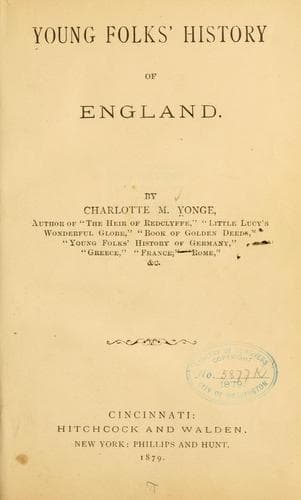
Young Folks' History of EnglandYonge, Charlotte M. (Charlotte Mary)
History
Young Folks' History of England
Yonge, Charlotte M. (Charlotte Mary)
Great Britain -- History -- Juvenile literature
This rising of the Jacobites took place in the year 1715, and is,
therefore, generally called the Rebellion of the Fifteen. The chief
noblemen who were engaged in it were taken to London to be tried.
Three were beheaded; one was saved upon his wife's petition; and one,
the Earl of Nithsdale, by the cleverness of his wife. She was allowed
to go and see him in the Tower, and she took a tall lady in with her,
who contrived to wear a double set of outer garments. The friend
went away, after a time; and then, after waiting till the guard was
changed, Lady Nithsdale dressed her husband in the clothes that had
been brought in: and he, too, went away, with the hood over his face
and a handkerchief up to his eyes, so that the guard might take him
for the other lady, crying bitterly at parting with the earl. The
wife, meantime, remained for some time, talking and walking up and
down as heavily as she could, till the time came when she would
naturally be obliged to leave him--when, as she passed by his servant,
she said to him that "My lord will not be ready for the candles just
yet,"--and then left the Tower, and went to a little lodging in a
back street, where she found her husband, and where they both lay hid
while the search for Lord Nithsdale was going on, and where they heard
the knell tolling when his friends, the other lords, were being led out
to have their heads cut off. Afterwards, they made their escape to
France, where most of the Jacobites who had been concerned in the
rising were living, as best they could, on small means--and some of
them by becoming soldiers of the King of France.
England was prosperous in the time of George I., and the possessions
of the country in India were growing, from a merchant's factory here
and there, to large lands and towns. But the English never liked King
George, nor did he like them; and he generally spent his time in his
own native country of Hanover. He was taking a drive there in his
coach, when a letter was thrown in at the window. As he was reading
it, a sudden stroke of apoplexy came on, and he died in a few hours'
time. No one ever knew what was in the letter, but some thought it
was a letter reproaching him with his cruelty to his poor wife, who
had died in her prison about eight months before. He died in the
year 1725.
Gentlemen were leaving off full-bottomed wigs now, and wearing smaller
ones; and younger men had their own hair powdered, and tied up with
ribbon in a long tail behind, called a queue. Ladies powdered their
hair, and raised it to an immense height, and also wore monstrous
hoops, long ruffles, and high-heeled shoes. Another odd fashion was
that ladies put black patches on their faces, thinking they made them
handsomer. Both ladies and gentlemen took snuff, and carried beautiful
snuff-boxes.
CHAPTER XLII.
GEORGE II. A.D. 1725--1760.
Public-domain text, read in full here on John Shaqi.
Reviews
Reviews
No reviews yet
Be the first to share your thoughts on this work.
Elsewhere in the archive
Join the Discussion
Join the discussion
Sign in to leave a comment or review.
Sign InorCreate an account