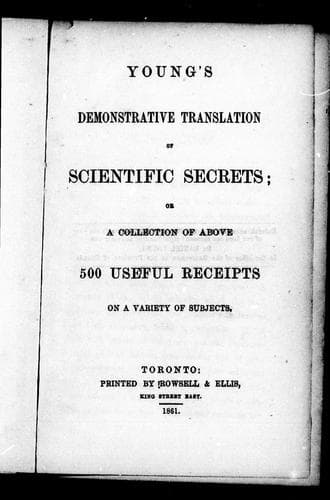
Young's Demonstrative Translation of Scientific Secrets: Or, A Collection of Above 500 Useful Receipts on a Variety of SubjectsYoung, Daniel
Science
Young's Demonstrative Translation of Scientific Secrets: Or, A Collection of Above 500 Useful Receipts on a Variety of Subjects
Young, Daniel
Formulas, recipes, etc.; Science -- Methodology
This is made by the addition of blue black in powder, or lamp-black
to receipt No. 261, till the colour is to the painter's mind; and a
lighter brown may be formed by adding ground white lead. By ground
lead is meant white lead ground in oil.
263. YELLOW PAINT
This is prepared with yellow ochre in powder, to receipt No. 261, in
the same proportion as Spanish brown.
264. BLACK PAINT
This is also prepared in the same proportion, as in receipt No. 261,
using lamp-black or blue-black, instead of Spanish brown.
265. WHITE PAINT
Slack a peck of nice, clean, fresh lime in a covered vessel, with
water which is boiling hot; when well slacked, strain it well, then
add to it 1-1/2 lbs. of finely ground rice; let the rice be boiled
to a thin paste, and stirred in while very hot; 1/2 peck of common
salt, well dissolved in warm water; 1/2 lb. of clean glue, dissolved
in water; and 1/4 lb. of whiting; when well mixed, add 5 gallons
of very hot water, then stir well, and let stand a few days well
covered. Pit it on hot, and it will stand the weather as well as
a good deal of white lead. You may colour this paint to suit your
taste, using and stirring in well Spanish brown for a red pink
colour. Take common clay finely powdered, and mixed well with
Spanish brown for a reddish stone-colour. For yellow colour use
yellow ochre if you please, but chrome yellow makes a richer colour
and less does. You may make the colours dark or light according to
the quantity of colouring matter used.
266. COMPOUND COLOURED PAINTS
The various colours that may be obtained by the mixture of other
colours, are innumerable. I only propose here to give the best
and simplest modes of preparing those which are required for use.
Compound colours, formed by the union of only two colours, are
called by painters virgin tints. The smaller the number of colours
of which any compound colour is composed, the purer and the richer
it will be. They are prepared as follows:
267. LIGHT GREY
This is made by mixing white lead with lamp-black, using more or
less of each material, as you wish to obtain a darker or lighter
colour.
268. BUFF COLOUR
This is made from yellow ochre and white lead.
269. SILVER OR PEARL GREY
Mix white lead, indigo, and a very light portion of black,
regulating the quantities by the shade you wish to obtain.
270. FLAXEN GREY
This is obtained by a mixture of white lead and Prussian blue, with
a small quantity of lake.
271. BRICK COLOUR
This is prepared by mixing yellow ochre, and red lead, with a little
white lead.
272. OAK WOOD COLOUR
Mix together three-fourths white lead, and one-fourth part umber and
yellow ochre; the proportions of the last two ingredients being
determined by the required tints.
273. WALNUT TREE COLOUR
Two-thirds white lead, and one-third red ochre, yellow ochre, and
umber, mixed according to the shade sought. If veining is required,
use different shades of the same mixture, and for the deepest
places, black.
274. JONQUIL
Public-domain text, read in full here on John Shaqi.
Reviews
Reviews
No reviews yet
Be the first to share your thoughts on this work.
Join the Discussion
Join the discussion
Sign in to leave a comment or review.
Sign InorCreate an account