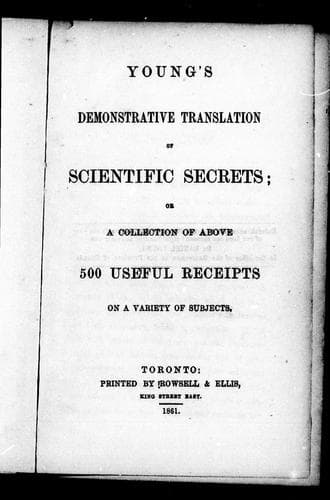
Young's Demonstrative Translation of Scientific Secrets: Or, A Collection of Above 500 Useful Receipts on a Variety of SubjectsYoung, Daniel
Science
Young's Demonstrative Translation of Scientific Secrets: Or, A Collection of Above 500 Useful Receipts on a Variety of Subjects
Young, Daniel
Formulas, recipes, etc.; Science -- Methodology
Grind 96 lbs. of English ochre with boiled oil, and add to it 16
lbs. of black paint; dissolve 1 lb. of yellow soap in one pail of
water, on the fire, and mix it while hot with the paint. Lay this
composition, without wetting it, upon the canvass, as stiff as can
conveniently be done with the brush, so as to form a smooth surface;
the next day, or the day after, (if the latter, so much the better,)
lay on a second coat of ochre and black, with a very little, if any,
soap; allow this coat a day to dry, and then finish the canvass with
black paint.
526. PHOTOCROMATIC OIL PAINTING
INSTRUCTION:
Chemicals used in executing them:--chemical varnish, No. 1, 2 oz.
damar varnish, 1 oz. spirits turpentine; (mix well together.)
Finishing varnish, No. 2, 1 oz. spirits turpentine, 1 oz. alcohol,
1 oz. salt, 1 quart water. A camel's hair brush is needed for
varnishing. Take a smooth pane of common window-glass, any size you
choose, clean it well, then varnish one side of it with chemical
varnish No. 1, lay it away where it will be perfectly free from
dust, and let it dry twenty-four hours; next varnish the same side
of the glass again, and let it dry about one half hour, or until the
varnish becomes stickey. Immediately after varnishing the glass the
second time, take the print that you wish to get an impression of,
and immerse it in the solution No. 3; put the solution in a flat
pan, and lay the print in with the face side up; let the print lay
in the solution about five minutes, or until the paper is completely
saturated, then remove it, taking care not to stretch it, and lay it
on paper with the face side up, in order that the solution may dry
from the face of the print. In this way prepare the print, getting
it ready by the time the glass has dried one half hour. Next,
carefully lay the face of the print on the varnished side of the
glass, being particular to lay it on smooth and press it firmly to
the glass, so as to exclude every particle of air; should there be
any air left under the paper, it will show itself in spots, and
must be pressed out. You now lay it away and let it dry another
twenty-four hours; then, wet the back part of the print with water
and with your hand or a wet cloth, rub the paper from the back of
the print until it is so thin that the outlines of the picture can
be seen from the back and of uniform thickness. You next spread a
thin coat of finishing varnish (No. 2) on it and lay it away to dry.
This will render it perfectly clear and transparent.--After this
coat of varnish has dried, rub it over with a bit of fine sand
paper, to make it smooth, and finish with two or three coats of
No. 2 varnish. When dry, put it in a frame with the varnished side
out, placing a sheet of light coloured paper on the back, this will
give it the appearance of an oil painting. By following these
directions you cannot fail to produce a beautiful picture.
527. FOR THE COMPLEXION
Public-domain text, read in full here on John Shaqi.
Reviews
Reviews
No reviews yet
Be the first to share your thoughts on this work.
Elsewhere in the archive
Join the Discussion
Join the discussion
Sign in to leave a comment or review.
Sign InorCreate an account