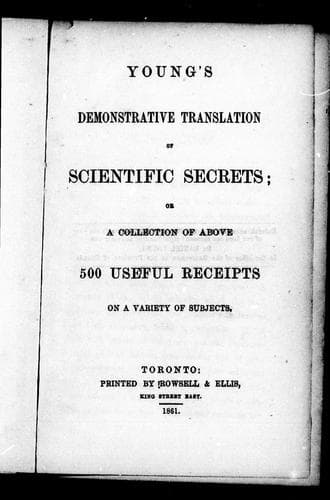
Young's Demonstrative Translation of Scientific Secrets: Or, A Collection of Above 500 Useful Receipts on a Variety of SubjectsYoung, Daniel
Science
Young's Demonstrative Translation of Scientific Secrets: Or, A Collection of Above 500 Useful Receipts on a Variety of Subjects
Young, Daniel
Formulas, recipes, etc.; Science -- Methodology
Take 2 ozs. of tripoli, reduced to fine powder; put it into an
earthen pot or basin, with water to cover it; then take a piece of
fine flannel, four times doubled, lay it over a piece of cork or
rubber, and proceed to polish your varnish, always wetting it with
the tripoli and water. You will know when the process is completed,
by wiping a part of the work with a sponge and observing whether
there is a fair and even gloss. Take a bit of mutton-suet and fine
flour, and clean off the work. Or, the powdered tripoli may be mixed
up with a little pure oil, and used upon a ball of serge, or of
chamois leather, which is better. The polishing may afterwards be
completed with a bit of serge or cloth, without tripoli. Putty
powder, and even common whiting and water, are sometimes used for
polishing; but they produce a very inferior effect to tripoli,
except in the case of ivory, for which putty and water, used upon a
rubber made of a hat, forms the best and quickest polish. Putty and
water may likewise be used, in the same manner as just mentioned for
ivory, in finishing off the polish of pearl work, after it has first
been polished very smooth with pumice-stone, finely powdered, and
well washed to free it from impurities and dirt.
538. VARNISH FOR COLOURED DRAWINGS
Mix together 1 oz. of Canada balsam and 2 ozs. of spirits of
turpentine. Before applying the composition, size the drawing or
print with a solution of isinglass in water; when this is dry, apply
the varnish with a camel's-hair brush. The use of this varnish gives
to coloured drawings and prints an appearance resembling that of oil
paintings.
539. VARNISH FOR GLASS
Reduce a quantity of gum tragacanth to powder, and let it dissolve
for twenty-four hours in the white of eggs well beat up; then rub it
gently on the glass with a brush.
540. TO CLEAN PICTURES
Having taken the picture out of its frame, take a clean towel, and
making it quite wet, lay it on the face of your picture, sprinkling
it from time to time with clear soft water; let it remain wet for
two or three days; take the cloth off, and renew it with a fresh
one; after wiping your picture with a clean wet sponge, repeat the
process till you find all the dirt soaked out of your picture; then
wash it well with a soft sponge, and let it get quite dry; rub it
with some clear nut or linseed oil, and it will look as well as when
freshly done.
541. ANOTHER METHOD
Put into two quarts of strong lye a quarter of a pound of Genoa soap
rasped very fine, with about a pint of spirits of wine; let them
simmer on the fire for half an hour, then strain them through a
cloth; apply it with a brush to the picture, wipe it off with a
sponge, and apply it a second time, which will effectually remove
all dirt; then, with a little nut oil warmed, rub the picture, and
let it dry; this will make it look as bright as when it came out of
the artist's hands.
542. VARNISH FOR CLOCK FACES, &c.
Public-domain text, read in full here on John Shaqi.
Reviews
Reviews
No reviews yet
Be the first to share your thoughts on this work.
Elsewhere in the archive
Join the Discussion
Join the discussion
Sign in to leave a comment or review.
Sign InorCreate an account