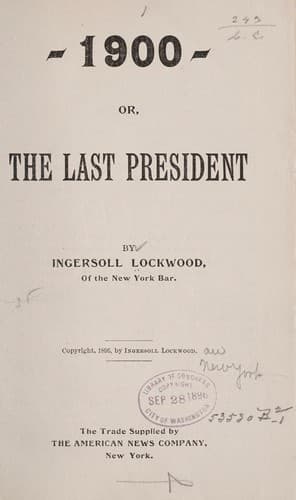
United States -- Politics and government -- Fiction
Said he: “Mr. Speaker, for nearly thirty years our people, although left
impoverished by the conflict of the states, have given of their
substance to salve the wounds and make green the old age of the men who
conquered us. We have paid this heavy tax, this fearful blood money
unmurmuringly. You have forgiven us for our bold strike for liberty that
God willed should not succeed. You have given us back our rights, opened
the doors of these sacred halls to us, called us your brothers, but
unlike noble Germany who was content to exact a lump sum from “la belle
France,” and then bid her go in peace and freedom from all further
exactions, you have for nearly thirty years laid this humiliating war
tax upon us, and thus forced us year in and year out to kiss the very
hand that smote us. Are we human that we now cry out against it? Are we
men that we feel no tingle in our veins after these long years of
punishment for no greater crime than that we loved liberty better than
the bonds of a confederation laid upon us by our fathers? We appeal to
you as our brothers and our countrymen. Lift this infamous tax from our
land, than which your great North is ten thousand times richer. Do one
of two things: Either take our aged and decrepit soldiers by the hand
and bless their last days with pensions from the treasury of our common
country, for they were only wrong in that their cause failed, or remove
this hated tax and make such restitution of this blood money as shall
seem just and equitable to your soberer and better judgment.”
To say that this speech, of which the foregoing is but a brief extract,
threw both Houses of Congress into most violent disorder, but faintly
describes its effect. Cries of treason! treason! went up; blows were
exchanged and hand to hand struggles took place in the galleries,
followed by the flash of the dread bowie and the crack of the ready
pistol. The Republic was shaken to its very foundations. Throughout the
North there was but a repetition of the scenes that followed the firing
upon Sumter. Public meetings were held, and resolutions passed calling
upon the Government to concentrate troops in and about Washington, and
prepare for the suppression of a second Rebellion.
But gradually this outbreak of popular indignation lost some of its
strength and virulence, for it was easy to comprehend that nothing would
be gained at this stage of the matter by meeting a violent and unlawful
demand with violence and unwise counsels. Besides, what was it any way
but the idle threat of a certain clique of unscrupulous politicians?
The Republic stood upon too firm a foundation to be shaken by mere
appeals to the passions of the hour. To commit treason against our
country called for an overt act. What had it to dread from the mere
oratorical flash of a passing storm of feeling?
Public-domain text, read in full here on John Shaqi.
Reviews
Reviews
No reviews yet
Be the first to share your thoughts on this work.
Join the Discussion
Join the discussion
Sign in to leave a comment or review.
Sign InorCreate an account