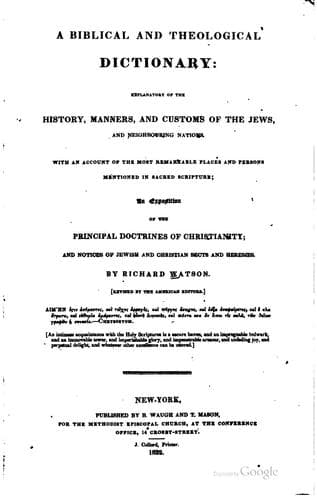
A Biblical and Theological Dictionary: explanatory of the history, manners, and customs of the Jews, and neighbouring nationsWatson, Richard
Religion
A Biblical and Theological Dictionary: explanatory of the history, manners, and customs of the Jews, and neighbouring nations
Watson, Richard
Bible -- Dictionaries; Theology -- Dictionaries
2. That the sacred writers should so frequently dwell upon the
omnipotence of God, has important reasons which arise out of the very
design of the revelation which they were the means of communicating to
mankind. Men were to be reminded of their obligations to obedience; and
God is therefore constantly exhibited as the Creator, the Preserver, and
Lord of all things. His solemn worship and fear were to be enjoined upon
them; and, by the manifestation of his works, the veil was withdrawn
from his glory and majesty. Idolatry was to be checked and reproved, and
the true God was therefore placed in contrast with the limited and
powerless gods of the Heathen: “Among the gods of the nations, is there
no god like unto thee; neither are there any works like thy works.”
Finally, he is exhibited as the object of _trust_ to creatures
constantly reminded by experience of their own infirmity and dependence;
and to them it is essential to know, that his power is absolute,
unlimited, and irresistible, and that, in a word, he is “mighty to
save.”
3. In a revelation which was thus designed to awe and control the
wicked, and to afford strength of mind and consolation to good men under
all circumstances, the omnipotence of God is therefore placed in a great
variety of impressive views, and connected with the most striking
illustrations.
It is declared by the fact of _creation_, the creation of beings out of
_nothing_; which itself, though it had been confined to a single object,
however minute, exceeds finite comprehension, and overwhelms the
faculties. This with God required no effort: “He spake and it was done,
he commanded and it stood fast.” The _vastness_ and _variety_ of his
works enlarge the conception: “The heavens declare the glory of God, and
the firmament showeth his handy work.” “He spreadeth out the heavens,
and treadeth upon the waves of the sea; he maketh Arcturus, Orion, and
Pleiades, and the chambers of the south; he doeth great things, past
finding out, yea, and wonders without number. He stretcheth out the
north over the empty place, and hangeth the earth upon nothing. He
bindeth up the waters in the thick clouds, and the cloud is not rent
under them; he hath compassed the waters with bounds until the day and
night come to an end.” The _ease_ with which he sustains, orders, and
controls the most powerful and unruly of the elements, arrays his
omnipotence with an aspect of ineffable dignity and majesty: “By him all
things consist.” “He brake up for the sea a decreed place, and set bars
and doors, and said, Hitherto shalt thou come and no farther, and here
shall thy proud waves be stayed.” “He looketh to the end of the earth,
and seeth under the whole heaven, to make the weight for the winds, to
weigh the waters by measure, to make a decree for the rain, and a way
for the lightning of the thunder.” “Who hath measured the waters in the
hollow of his hand, meted out heaven with a span, comprehended the dust
Public-domain text, read in full here on John Shaqi.
Reviews
Reviews
No reviews yet
Be the first to share your thoughts on this work.
Elsewhere in the archive
Join the Discussion
Join the discussion
Sign in to leave a comment or review.
Sign InorCreate an account