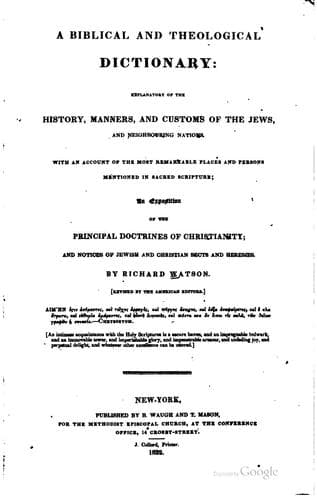
A Biblical and Theological Dictionary: explanatory of the history, manners, and customs of the Jews, and neighbouring nationsWatson, Richard
Religion
A Biblical and Theological Dictionary: explanatory of the history, manners, and customs of the Jews, and neighbouring nations
Watson, Richard
Bible -- Dictionaries; Theology -- Dictionaries
ALMAH, עלמה, a Hebrew word signifying properly _a virgin_, a young woman
unacquainted with man. In this sense it occurs in the famous passage of
Isaiah, vii, 14: “Behold a virgin shall conceive and bear a son.” The
Hebrew has no term that more properly signifies a virgin than _almah_.
St. Jerom, in his commentary on this passage, observes, that the Prophet
declined using the word _bethaul_ which signifies any young woman, or
young person, but employed the term _almah_, which denotes a virgin
never seen by man. This is the import of the word _almah_, which is
derived from a root which signifies _to conceal_. It is very well known,
that young women in the east do not appear in public, but are shut up in
their houses, and their mothers’ apartments, like nuns. The Chaldee
paraphrast and the Septuagint translate _almah_ “a virgin;” and Akiba,
the famous rabbin, who was a great enemy to Christ and Christians, and
lived in the second century, understands it in the same manner. The
Apostles and Evangelists, and the Jews of our Saviour’s time, explained
it in the same sense, and expected a Messiah born of a virgin.
The Jews, that they may obscure this plain text, and weaken this proof
of the truth of the Christian religion, pretend that the Hebrew word
signifies a young woman, and not a virgin. But this corrupt translation
is easily confuted. 1. Because this word constantly denotes a virgin in
all other passages of Scripture in which it is used. 2. From the intent
of the passage, which was to confirm their faith by a strange and
wonderful sign. It surely could be no wonder, that a young woman should
conceive a child; but it was a very extraordinary circumstance that a
virgin should conceive and bear a son.
ALMIGHTY, an attribute of the Deity, Gen. xvii, 1. The Hebrew name, שדי,
_Shaddai_, signifies also _all-sufficient_, or _all-bountiful_. See Gen.
xxviii, 3; xxxv, 11; xliii, 14; xlix, 25. Of the omnipotence of God, we
have a most ample revelation in the Scriptures, expressed in the most
sublime language. From the annunciation by Moses of a divine existence
who was “in the beginning,” before all things, the very first step is to
the display of his almighty power in the creation out of nothing, and
the immediate arrangement in order and perfection, of the “_heaven and
the earth_;” by which is meant, not this globe only with its atmosphere,
or even with its own celestial system, but the universe itself; for “_he
made the stars also_.” We are thus at once placed in the presence of an
agent of unbounded power; for we must all feel that a being which could
create such a world as this, must, beyond all comparison, possess a
power greater than any which we experience in ourselves, than any which
we observe in other visible agents, and to which we are not authorized
by our observation or knowledge to assign any limits of space or
duration.
Public-domain text, read in full here on John Shaqi.
Reviews
Reviews
No reviews yet
Be the first to share your thoughts on this work.
Elsewhere in the archive
Join the Discussion
Join the discussion
Sign in to leave a comment or review.
Sign InorCreate an account