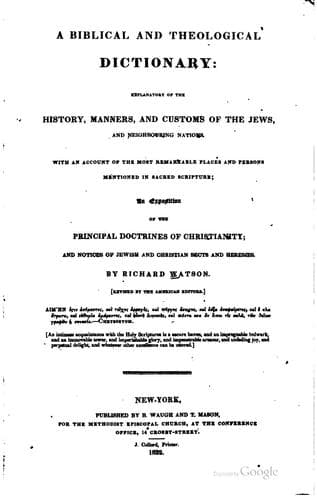
A Biblical and Theological Dictionary: explanatory of the history, manners, and customs of the Jews, and neighbouring nationsWatson, Richard
Religion
A Biblical and Theological Dictionary: explanatory of the history, manners, and customs of the Jews, and neighbouring nations
Watson, Richard
Bible -- Dictionaries; Theology -- Dictionaries
annihilate all other power whatever; which operates in the most perfect
manner, at once, in an instant, with the utmost ease; but the Scriptures
lead us to the contemplation of greater and even unfathomable depths.
The omnipotence of God is inconceivable and boundless. It arises from
the infinite perfection of God, that his power can never be actually
exhausted; and, in every imaginable instant in eternity, that
inexhaustible power of God can, if it please him, be adding either more
creatures to those in existence, or greater perfection to them; since
“it belongs to self-existent being, to be always full and communicative,
and, to the communicated contingent being, to be ever empty and
craving.”
7. One limitation of the divine power it is true we can conceive, but it
detracts nothing from its perfection. Where things in themselves imply a
contradiction, as that a body may be extended and not extended, in a
certain place and not in it, at the same time; such things cannot be
done by God, because contradictions are impossible in their own nature.
Nor is it any derogation from the divine power to say, they cannot be
done; for as the object of the understanding, of the eye, and the ear,
is that which is intelligible, visible, and audible; so the object of
power must be that which is possible; and as it is no prejudice to the
most perfect understanding, or sight, or hearing, that it does not
understand what is not intelligible, or see what is not visible, or hear
what is not audible; so neither is it any diminution to the most perfect
power, that it does not do what is not possible. In like manner, God
cannot do any thing that is repugnant to his other perfections: he
cannot lie, nor deceive, nor deny himself; for this would be injurious
to his truth. He cannot love sin, nor punish innocence; for this would
destroy his holiness and goodness: and therefore to ascribe a power to
him that is inconsistent with the rectitude of his nature, is not to
magnify but debase him; for all unrighteousness is weakness, a defection
from right reason, a deviation from the perfect rule of action, and
arises from a want of goodness and power. In a word, since all the
attributes of God are essentially the same, a power in him which tends
to destroy any other attribute of the divine nature, must be a power
destructive of itself. Well, therefore, may we conclude him absolutely
omnipotent, who, by being able to effect all things consistent with his
perfections, showeth infinite ability, and, by not being able to do any
thing repugnant to the same perfections, demonstrates himself subject to
no infirmity.
Public-domain text, read in full here on John Shaqi.
Reviews
Reviews
No reviews yet
Be the first to share your thoughts on this work.
Elsewhere in the archive
Join the Discussion
Join the discussion
Sign in to leave a comment or review.
Sign InorCreate an account