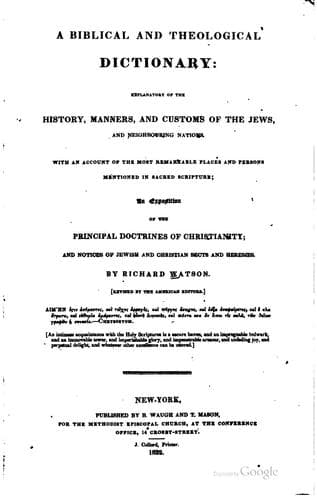
A Biblical and Theological Dictionary: explanatory of the history, manners, and customs of the Jews, and neighbouring nationsWatson, Richard
Religion
A Biblical and Theological Dictionary: explanatory of the history, manners, and customs of the Jews, and neighbouring nations
Watson, Richard
Bible -- Dictionaries; Theology -- Dictionaries
8. Nothing certainly in the finest writings of antiquity, were all their
best thoughts collected as to the majesty and power of God, can bear any
comparison with the views thus presented to us by divine revelation.
Were we to forget, for a moment, what is the fact, that their noblest
notions stand connected with fancies and vain speculations which deprive
them of their force, still their thoughts never rise so high; the
current is broken, the round of lofty conception is not completed, and,
unconnected as their views of divine power were with the eternal destiny
of man, and the very reason of creation, we never hear in them, as in
the Scriptures, “the THUNDER of his power.”
ALMOND TREE, לוז. Arabic, _lauz_. Translated _hazel_, Gen. xxx, 37; שקד,
rendered _almond_, Gen. xliii, 11; Exod. xxv, 33, 34; xxxvii, 19, 20;
Num. xvii, 8; Eccles. xii, 5; and Jer. i, 11. The first name may be that
of the _tree_; the other, that of the _fruit_, or _nut_.
A tree resembling the peach tree in its leaves and blossoms, but the
fruit is longer and more compressed, the outer green coat is thinner and
drier when ripe, and the shell of the stone is not so rugged. This
stone, or nut, contains a kernel, which is the only esculent part. The
whole arrives at maturity in September, when the outer tough cover
splits open and discharges the nut. From the circumstance of its
blossoming the earliest of any of the trees, beginning as soon as the
rigour of winter is past, and before it is in leaf, it has its Hebrew
name _shakad_, which comes from a verb signifying _to make haste_, _to
be in a hurry_, or _to awake early_. To the forwardness of the almond
tree there seems to be a reference in Jeremiah: “The word of the Lord
came unto me, saying, Jeremiah, what seest thou? And I said, I see a rod
of an almond tree. Then said the Lord unto me, Thou hast well seen: for
I will hasten my word to perform it;” or rather, “I am hastening, or
watching over my word to fulfil it,” Jer. i, 11, 12. In this manner it
is rendered by the Seventy; and by the Vulgate, _Vigilabo ego super
verbum meum_. [I will watch over my word.] This is the first vision with
which the Prophet was honoured; and his attention is roused by a very
significant emblem of that severe correction with which the Most High
was hastening to visit his people for their iniquity; and from the
species of tree to which the rod belonged, he is warned of its near
approach. The idea which the appearance of the almond rod suggested to
his mind, is confirmed by the exposition of God himself: “I am watching
over, or on account of, my word to fulfil it;” and this double mode of
instruction, first by emblem, and then by exposition, was certainly
intended to make a deeper impression on the mind both of Jeremiah and of
the people to whom he was sent.
Public-domain text, read in full here on John Shaqi.
Reviews
Reviews
No reviews yet
Be the first to share your thoughts on this work.
Elsewhere in the archive
Join the Discussion
Join the discussion
Sign in to leave a comment or review.
Sign InorCreate an account