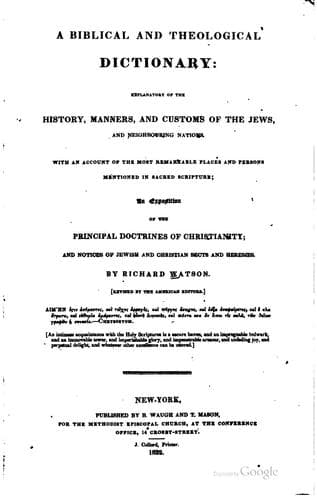
A Biblical and Theological Dictionary: explanatory of the history, manners, and customs of the Jews, and neighbouring nations — John Shaqi
A Biblical and Theological Dictionary: explanatory of the history, manners, and customs of the Jews, and neighbouring nationsWatson, Richard
Religion
A Biblical and Theological Dictionary: explanatory of the history, manners, and customs of the Jews, and neighbouring nations
Watson, Richard
Bible -- Dictionaries; Theology -- Dictionaries
ABEL. He was the second son of Adam and Eve, and born probably in the
second or third year of the world; though some will have it that he and
Cain were twins. His name signifies _vapour_, _vanity_, and might be
given either because our first parents now began so to feel the
emptiness and vanity of all earthly things, that the birth of another
son reminded them painfully of it, although in itself a matter of joy;
or it was imposed under prophetic impulse, and obscurely referred to his
premature death. His employment was that of a shepherd; Cain followed
the occupation of his father, and was a tiller of the ground. Whether
they remained in their father’s family at the time when they brought
their offerings to the Lord, or had establishments separate from that of
Adam, does not clearly appear. Abel was probably unmarried, or had no
children; but Cain’s wife is mentioned. “At the end of the days,”--which
is a more literal rendering than “in process of time,” as in our
translation, that is, on the Sabbath,--both brothers brought an offering
to the Lord. Cain “brought of the fruit of the ground;” Abel “the
firstlings of his flock, and of the fat thereof.” “And the Lord had
respect to Abel and to his offering; but unto Cain and his offering he
had not respect.” As Cain afterward complains that “he should be hid
from the _face_ or _presence_ of the Lord,” it is probable that the
worship of the first family was performed before some visible
manifestation of the glory of God, which thus consecrated a particular
place for their services. Some have thought that this was at the east
gate of Eden, where “Cherubim and a flaming sword were placed;” but this
was a vengeful manifestation, and could only have inspired a dread of
God inconsistent with the confidence and hope with which men through the
promise of redemption were now encouraged to draw nigh to him. The
respect which God was pleased to show to Abel’s offering, appears from
the account to have been sensibly declared; for Cain must have known by
some token that the sacrifice of Abel was accepted, the absence of which
sign, as to his own offering, showed that it was rejected. Whether this
was by fire going forth from “the presence of the Lord,” to consume the
sacrifice, as in later instances recorded in the Old Testament, or in
some other way, it is in vain to inquire;--that the token of acceptance
was a sensible one is however an almost certain inference. The effect of
this upon Cain was not to humble him before God, but to excite anger
against his brother; and, being in the field with him, or, as the old
versions have it, having said to him, “Let us go out into the field,”
“he rose up against Abel his brother, and slew him;” and for that crime,
by which the first blood of man was shed by man upon the earth,--a
murder aggravated by the relationship and the “righteous” character of
the sufferer, and having in it also the nature of religious
Public-domain text, read in full here on John Shaqi.
Reviews
Reviews
No reviews yet
Be the first to share your thoughts on this work.
Join the Discussion
Join the discussion
Sign in to leave a comment or review.
Sign InorCreate an account