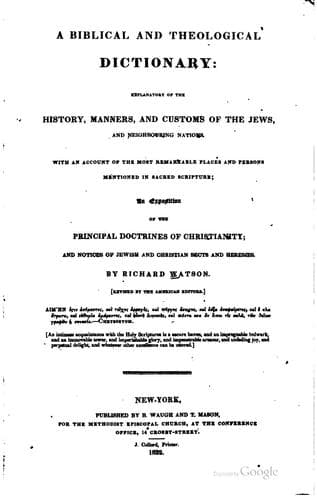
A Biblical and Theological Dictionary: explanatory of the history, manners, and customs of the Jews, and neighbouring nationsWatson, Richard
Religion
A Biblical and Theological Dictionary: explanatory of the history, manners, and customs of the Jews, and neighbouring nations
Watson, Richard
Bible -- Dictionaries; Theology -- Dictionaries
2. ALPHEUS, father of Levi, or Matthew, whom Jesus took to be an Apostle
and Evangelist, Mark ii, 14.
ALTAR. Sacrifices are nearly as ancient as worship, and altars are of
almost equal antiquity. Scripture speaks of altars, erected by the
patriarchs, without describing their form, or the materials of which
they were composed. The altar which Jacob set up at Bethel, was the
stone which had served him for a pillow; Gideon sacrificed on the rock
before his house. The first altars which God commanded Moses to raise,
were of earth or rough stones; and it was declared that if iron were
used in constructing them they would become impure, Exod. xx, 24, 25.
The altar which Moses enjoined Joshua to build on Mount Ebal, was to be
of unpolished stones, Deut. xxvii, 5; Josh. viii, 31; and it is very
probable that such were those built by Samuel, Saul, and David. The
altar which Solomon erected in the temple was of brass, but filled, it
is believed, with rough stones, 2 Chron. iv, 1–3. It was twenty cubits
long, twenty wide, and ten high. That built at Jerusalem, by Zerubbabel,
after the return from Babylon, was of rough stones; as was that of
Maccabees. Josephus says that the altar which in his time was in the
temple was of rough stones, fifteen cubits high, forty long, and forty
wide.
Among the Romans altars were of two kinds, the higher and the lower; the
higher were intended for the celestial gods, and were called _altaria_,
from _altus_; the lower were for the terrestrial and infernal gods, and
were called _aræ_. Those dedicated to the heavenly gods were raised a
great height above the surface of the earth; those of the terrestrial
gods were almost even with the surface; and those for the infernal
deities were only holes dug in the ground called _scrobiculi_.
Before temples were in use the altars were placed in the groves,
highways, or on tops of mountains, inscribed with the names, ensigns, or
characters of the respective gods to whom they belonged. The great
temples at Rome generally contained three altars; the first in the
sanctuary, at the foot of the statue, for incense and libations; the
second before the gate of the temple, for the sacrifices of victims; and
the third was a portable one for the offerings and sacred vestments or
vessels to lie upon. The ancients used to swear upon the altars upon
solemn occasions, such as confirming alliances, treaties of peace, &c.
They were also places of refuge, and served as an asylum and sanctuary
to all who fled to them, whatever their crimes were.
Public-domain text, read in full here on John Shaqi.
Reviews
Reviews
No reviews yet
Be the first to share your thoughts on this work.
Elsewhere in the archive
Join the Discussion
Join the discussion
Sign in to leave a comment or review.
Sign InorCreate an account