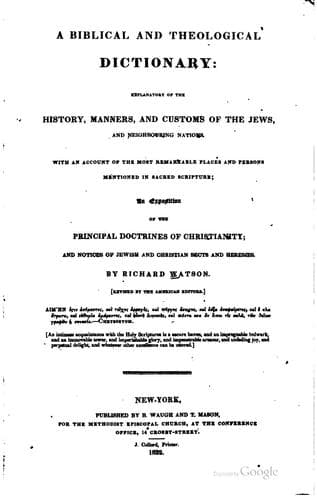
A Biblical and Theological Dictionary: explanatory of the history, manners, and customs of the Jews, and neighbouring nationsWatson, Richard
Religion
A Biblical and Theological Dictionary: explanatory of the history, manners, and customs of the Jews, and neighbouring nations
Watson, Richard
Bible -- Dictionaries; Theology -- Dictionaries
The LIGN-ALOE, or agallochum, Num. xxiv, 6; Psalm xlv, 9; and Cantic.
iv, 14. אהלת, masculine, אהל, whose plural is אהלים, is a small tree
about eight or ten feet high. That the flower of this plant yielded a
fragrance, is assured to us in the following extract from Swinburne’s
Travels, letter xii: “This morning, like many of the foregoing ones, was
delicious. The sun rose gloriously out of the sea, and all the air
around was perfumed with the effluvia of the aloe, as its rays sucked up
the dew from the leaves.” This extremely bitter plant contains under the
bark three sorts of wood. The first is black, solid, and weighty; the
second is of a tawny colour, of a light spongy texture, very porous, and
filled with a resin extremely fragrant and agreeable; the third kind of
wood, which is the heart, has a strong aromatic odour, and is esteemed
in the east more precious than gold itself. It is used for perfuming
habits and apartments, and is administered as a cordial in fainting and
epileptic fits. These pieces, called calunbac, are carefully preserved
in pewter boxes, to prevent their drying. When they are used they are
ground upon a marble with such liquids as are best suited to the purpose
for which they are intended. This wood, mentioned Cantic. iv, 14, in
conjunction with several other odoriferous plants there referred to, was
in high esteem among the Hebrews for its exquisite exhalations.
The scented aloe, and each shrub that showers
Gum from its veins, and odours from its flowers.
Thus the son of Sirach, Ecclesiasticus xxiv, 15: “I gave a sweet smell
like the cinnamon and aspalathus. I yielded a pleasant odour like the
best myrrh; like galbanum and onyx, and fragrant storax, and like the
fume of frankincense in the tabernacle.” It may not be amiss to observe
that the Persian translator renders _ahalim_, sandal wood; and the same
was the opinion of a certain Jew in Arabia who was consulted by Neibuhr.
ALPHA, the first letter of the Greek alphabet; Omega being the last
letter. Hence Alpha and Omega is a title which Christ appropriates to
himself, Rev. i, 8; xxi, 6; xxii, 13; as signifying the beginning and
the end, the first and the last, and thus properly denoting his
perfection and eternity.
ALPHEUS, father of James the less, Matt. x, 3; Luke vi, 15. Alpheus was
the husband of Mary, believed to have been sister to the mother of
Christ; for which reason, James is called the Lord’s brother; but the
term brother is too general in its application to fix their relation,
though the fact is probable. Many are of opinion that Cleopas, mentioned
Luke xxiv, 18, is the same as Alpheus; Alpheus being his Greek name, and
Cleopas his Hebrew, or Syriac name, according to the custom of this
province, (or of the time,) where men often had two names; by one of
which they were known to their friends and countrymen, by the other to
the Romans or strangers.
Public-domain text, read in full here on John Shaqi.
Reviews
Reviews
No reviews yet
Be the first to share your thoughts on this work.
Elsewhere in the archive
Join the Discussion
Join the discussion
Sign in to leave a comment or review.
Sign InorCreate an account