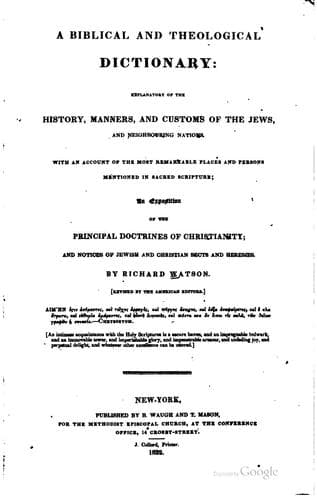
A Biblical and Theological Dictionary: explanatory of the history, manners, and customs of the Jews, and neighbouring nationsWatson, Richard
Religion
A Biblical and Theological Dictionary: explanatory of the history, manners, and customs of the Jews, and neighbouring nations
Watson, Richard
Bible -- Dictionaries; Theology -- Dictionaries
Sacrifices according to the laws of Moses, could not be offered except
by the priests; and at any other place than on the altar of the
tabernacle or the temple. Furthermore, they were not to be offered to
idols, nor with any superstitious rites. See Lev. xvii, 1–7; Deut. xii,
15, 16. Without these precautionary measures, the true religion would
hardly have been secure. If a different arrangement had been adopted, if
the priests had been scattered about to various altars, without being
subjected to the salutary restraint which would result from a mutual
observation of each other, they would no doubt some of them have
willingly consented to the worship of idols; and others, in their
separate situation, would not have been in a condition to resist the
wishes of the multitude, had those wishes been wrong. The necessity of
sacrificing at one altar, (that of the tabernacle or temple,) is
frequently and emphatically insisted on, Deut. xii, 13, 14; and all
other altars are disapproved, Lev. xxvi, 30, compare Joshua xxii, 9–34.
Notwithstanding this, it appears that, subsequently to the time of
Moses, especially in the days of the kings, altars were multiplied; but
they fell under suspicions, although some of them were perhaps sacred to
the worship of the true God. It is, nevertheless, true, that prophets,
whose characters were above all suspicion, sacrificed, in some
instances, in other places than the one designated by the laws, 1 Sam.
xiii, 3–14; xvi, 1–5; 1 Kings xviii, 21–40.
AMALEKITES, a people whose country adjoined the southern border of the
land of Canaan, in the north-western part of Arabia Petræa. They are
generally supposed to have been the descendants of Amalek, the son of
Eliphaz, and grandson of Esau. But Moses speaks of the Amalekites long
before this Amalek was born; namely in the days of Abraham, when
Chedorlaomer, king of Elam, devastated their country, Gen. xiv, 7; from
which it may be inferred that there was some other and more ancient
Amalek, from whom this people sprang. The Arabians have a tradition that
this Amalek was a son of Ham; and when we consider that so early as the
march from Egypt the Amalekites were a people powerful enough to attack
the Israelites, it is far more probable that they should derive their
ancestry from Ham, than from the then recent stock of the grandson of
Esau. It may also be said, that the character and fate of this people
were more consonant with the dealings of Providence toward the families
of the former. This more early origin of the Amalekites will likewise
explain why Balaam called them the “first of the nations.”
Public-domain text, read in full here on John Shaqi.
Reviews
Reviews
No reviews yet
Be the first to share your thoughts on this work.
Elsewhere in the archive
Join the Discussion
Join the discussion
Sign in to leave a comment or review.
Sign InorCreate an account