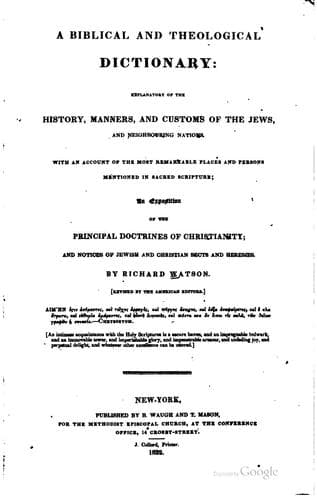
A Biblical and Theological Dictionary: explanatory of the history, manners, and customs of the Jews, and neighbouring nationsWatson, Richard
Religion
A Biblical and Theological Dictionary: explanatory of the history, manners, and customs of the Jews, and neighbouring nations
Watson, Richard
Bible -- Dictionaries; Theology -- Dictionaries
They are supposed by some to have been a party or tribe of the shepherds
who invaded Egypt, and kept it in subjection for two hundred years. This
will agree with the Arabian tradition as to their descent. It also
agrees with their pastoral and martial habits, as well as with their
geographical position; which was perhaps made choice of on their
retiring from Egypt, adjoining that of their countrymen the Philistines,
whose history is very similar. It also furnishes a motive for their
hostility to the Jews, and their treacherous attempt to destroy them in
the desert. The ground of this hostility has been very generally
supposed to have been founded in the remembrance of Jacob’s depriving
their progenitor of his birthright. But we do not find that the
Edomites, who had this ground for a hatred to the Jews, made any attempt
to molest them, nor that Moses ever reproaches the Amalekites for
attacking the Israelites as their brethren; nor do we ever find in
Scripture that the Amalekites joined with the Edomites, but always with
the Canaanites and the Philistines. These considerations would be
sufficient, had we no other reasons for believing them not to be of the
stock of Esau. They may, however, be deduced from a higher origin; and
viewing them as Cuthite shepherds and warriors, we have an adequate
explanation both of their imperious and warlike character, and of the
motive of their hostility to the Jews in particular. If expelled with
the rest of their race from Egypt, they could not but recollect the
fatal overthrow at the Red Sea; and if not participators in that
catastrophe, still, as members of the same family, they must bear this
event in remembrance with bitter feelings of revenge. But an additional
motive is not wanting for this hostility, especially for its first act.
The Amalekites probably knew that the Israelites were advancing to take
possession of the land of Canaan, and resolved to frustrate the purposes
of God in this respect. Hence they did not wait for their near approach
to that country, but came down from their settlements, on its southern
borders, to attack them unawares at Rephidim. Be this as it may, the
Amalekites came on the Israelites, when encamped at that place, little
expecting such an assault. Moses commanded Joshua, with a chosen band,
to attack the Amalekites; while he, with Aaron and Hur, went up the
mountain Horeb. During the engagement, Moses held up his hands to
heaven; and so long as they were maintained in this attitude, the
Israelites prevailed, but when through weariness they fell, the
Amalekites prevailed. Aaron and Hur, seeing this, held up his hands till
the latter were entirely defeated with great slaughter, Exod. xvii.
Public-domain text, read in full here on John Shaqi.
Reviews
Reviews
No reviews yet
Be the first to share your thoughts on this work.
Elsewhere in the archive
Join the Discussion
Join the discussion
Sign in to leave a comment or review.
Sign InorCreate an account