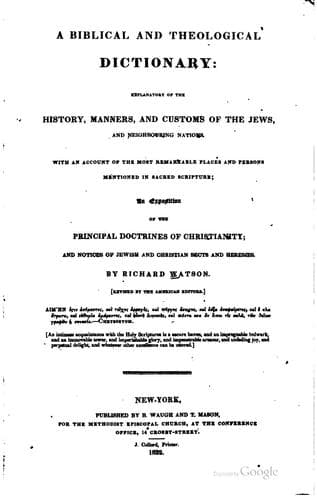
A Biblical and Theological Dictionary: explanatory of the history, manners, and customs of the Jews, and neighbouring nationsWatson, Richard
Religion
A Biblical and Theological Dictionary: explanatory of the history, manners, and customs of the Jews, and neighbouring nations
Watson, Richard
Bible -- Dictionaries; Theology -- Dictionaries
AMBER, השמל, Ezek. i, 4, 27; viii, 2. The amber is a hard inflammable
bitumen. When rubbed it is highly endowed with that remarkable property
called electricity, a word which the moderns have formed from its Greek
name ἠλέκτρον. But the ancients had also a mixed metal of fine copper
and silver, resembling the amber in colour, and called by the same name.
From the version of Ezekiel i, 4, by the LXX, Καὶ ἐν τῷ μέσω ἀυτου ὡς
ὅρασις ἠλεκτρȣ ἐν μέσῳ τοῦ ϖυρὸς, “And in the midst of it as the
appearance of electrum in the midst of the fire,” it appears that those
translators by ἠλέκτρον, could not mean amber, which grows dim as soon
as it feels the fire, and quickly dissolves into a resinous or pitchy
substance; but the mixed metal above mentioned, which is much celebrated
by the ancients for its beautiful lustre, and which, when exposed to the
fire like other metals, grows more bright and shining. St. Jerom,
Theodoret, St. Gregory and Origen think, that, in the above cited
passages from Ezekiel, a precious and highly polished metal is meant.
AMEN. אמן, in Hebrew, signifies _true_, _faithful_, _certain_. It is
used likewise in affirmation; and was often thus employed by our
Saviour: “Amen, amen,” that is, “Verily, verily.” It is also understood
as expressing a wish, “Amen! so be it!” or an affirmation, “Amen, yes, I
believe it:” Num. v, 22. She shall answer, “Amen! Amen!” Deut. xxvii,
15, 16, 17, &c. “All the people shall answer, Amen! Amen!” 1 Cor. xiv,
16. “How shall he who occupieth the place of the unlearned, say, Amen!
at thy giving of thanks? seeing he understandeth not what thou sayest.”
“The promises of God are Amen in Christ;” that is, certain, confirmed,
granted, 2 Cor. i, 20. The Hebrews end the five books of Psalms,
according to their distribution of them, with “Amen, amen;” which the
Septuagint translate, Γένοιτο, γένοιτο, and the Latins, _Fiat, fiat_.
The Gospels, &c, are ended with AMEN. The Greek, Latin, and other
churches, preserve this word in their prayers, as well as alleluia and
hosanna. At the conclusion of the public prayers, the people anciently
answered with a loud voice, “Amen!” and Jerom says, that, at Rome, when
the people answered, “Amen!” the sound was like a clap of thunder, _in
similitudinem cœlestis tonitrui Amen reboat_. [Amen rings again like
a peal of thunder.] The Jews assert that the gates of heaven are opened
to him who answers, “Amen!” with all his might.
The Jewish doctors give three rules for pronouncing the word: 1. That it
be not pronounced too hastily and rapidly, but with a grave and distinct
voice. 2. That it be not louder than the tone of him that blesses. 3.
That it be expressed in faith, with a certain persuasion that God would
bless them, and hear their prayers.
AMEN is a title of our Lord, “The Amen, the true and faithful witness,”
Rev. i, 14.
AMETHYST. אחלמה, Exod. xxviii, 19; and xxix, 12; and once in the New
Testament, Rev. XXI, 20, ἀμέθυϛος.
Public-domain text, read in full here on John Shaqi.
Reviews
Reviews
No reviews yet
Be the first to share your thoughts on this work.
Elsewhere in the archive
Join the Discussion
Join the discussion
Sign in to leave a comment or review.
Sign InorCreate an account