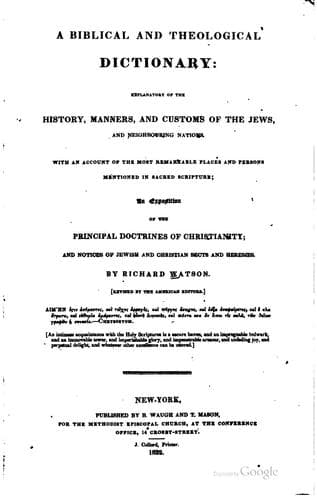
A Biblical and Theological Dictionary: explanatory of the history, manners, and customs of the Jews, and neighbouring nationsWatson, Richard
Religion
A Biblical and Theological Dictionary: explanatory of the history, manners, and customs of the Jews, and neighbouring nations
Watson, Richard
Bible -- Dictionaries; Theology -- Dictionaries
In the muster which Amaziah made of his people, he found three hundred
thousand men able to bear arms. He hired, besides, one hundred thousand
men of Israel; for which he paid the king of Israel a hundred talents,
about thirty-four thousand pounds English. His design was to employ
these troops against Edom, which had revolted from Judah, in the reign
of Joram, about fifty-four years before, 2 Kings, viii, 20. But a
prophet of the Lord came to him, and said, “O king, let not the army of
Israel go with thee; for the Lord is not with Israel.” Amaziah,
hereupon, sent back those troops; and they returning, strongly irritated
against Amaziah, dispersed themselves over the cities of Judah, from
Bethoron to Samaria, killed three thousand men, and carried off a great
booty, to make themselves amends for the loss of the plunder of Edom.
Amaziah, with his own forces gave battle to the Edomites in the Valley
of Salt, and defeated them; but having thus punished Edom, and taken
their idols, he adored them as his own deities. This provoked the Lord,
who permitted Amaziah to be so blinded as to believe himself invincible.
He therefore sent to defy the king of Israel, saying, “Come, let us look
one another in the face.” The motive of this challenge was probably to
oblige Joash, king of Israel, to repair the ravages which his troops had
committed on their return homewards. Joash answered him by the fable of
the cedar of Lebanon, and the thistle trodden down by a beast, 2 Kings
xiv, 8, 9. But Amaziah, deaf to these reasonings, advanced to
Bethshemesh, and was defeated and taken prisoner there, by Joash, who
carried him to Jerusalem. Joash ordered the demolition of four hundred
cubits of the city wall, carried to Samaria all the gold and silver, the
rich vessels of the house of God, the treasuries of the royal palace,
and the sons of those among his own people who had been hostages there.
Amaziah reigned after this, fifteen or sixteen years at Jerusalem, but
returned not to the Lord. He endeavoured to escape from a conspiracy to
Lachish; but was assassinated. He was buried with his ancestors in the
city of David, and Uzziah, or Azariah, his son, about sixteen years of
age, succeeded him.
AMBASSADOR, a messenger sent by a sovereign, to transact affairs of
great moment. Ministers of the Gospel are called ambassadors, because,
in the name of Jesus Christ the King of kings, they declare his will to
men, and propose the terms of their reconciliation to God, 2 Cor. v, 20;
Eph. vi, 20. Eliakim, Shebna, and Joah, the servants of king Hezekiah,
were called “ambassadors of peace.” In their master’s name they
earnestly solicited a peace from the Assyrian monarch, but were made “to
weep bitterly” with the disappointment and refusal, Isaiah xxxiii, 7.
Public-domain text, read in full here on John Shaqi.
Reviews
Reviews
No reviews yet
Be the first to share your thoughts on this work.
Elsewhere in the archive
Join the Discussion
Join the discussion
Sign in to leave a comment or review.
Sign InorCreate an account