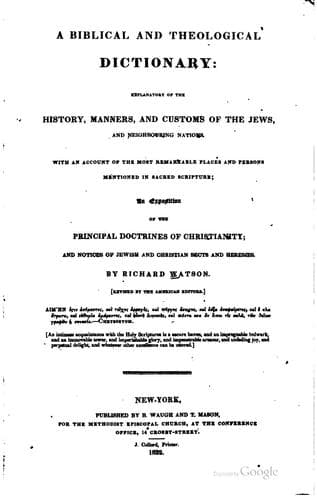
A Biblical and Theological Dictionary: explanatory of the history, manners, and customs of the Jews, and neighbouring nationsWatson, Richard
Religion
A Biblical and Theological Dictionary: explanatory of the history, manners, and customs of the Jews, and neighbouring nations
Watson, Richard
Bible -- Dictionaries; Theology -- Dictionaries
Ammon is by others derived from Ham, the son of Noah, who first peopled
Egypt and Lybia, after the flood; and, when idolatry began to gain
ground soon after this period, became the chief deity of those two
countries, in which his descendants continued. A temple, it is said, was
built to his honour, in the midst of the sandy deserts of Lybia, upon a
spot of good ground, about two leagues broad, which formed a kind of
island or oasis in a sea of sand. He was esteemed the Zeus of Greece,
and the Jupiter of Latium, as well as the Ammon of the Egyptians. In
process of time, these two names were joined; and he was called Jupiter
Ammon. For this reason the city of Ammon, No-ammon, or the city of Ham,
was called by the Greeks Diospolis, or the city of Jupiter. Plutarch
says, that of all the Egyptian deities which seemed to have any
correspondence with the Zeus of Greece, Amon or Ammon was the most
peculiar and appropriate. From Egypt his name and worship were brought
into Greece; as indeed were almost all the names of all the deities that
were there worshipped. Jupiter Ammon, or the Egyptian Jupiter, was
usually represented under the figure of a ram; though in some medals he
appears of a human shape, having only two ram’s horns growing out
beneath his ears. The Egyptians, says Proclus, in the Timæus of Plato,
had a singular veneration for the ram, because the image of Ammon bore
its head, and because this first sign of the zodiac was the presage of
the fruits of the earth. Eusebius adds, that this symbol marked the
conjunction of the sun and moon in the sign of the ram.
2. AMMON, or BEN-AMMI, the son of Lot, by his youngest daughter, Gen.
xix, 38. He was the father of the Ammonites, and dwelt on the east side
of the Dead Sea, in the mountains of Gilead.
AMMONIANS, the disciples of Ammonius Saccas, of the Alexandrian school.
His character was so equivocal, that it is disputed whether he was a
Heathen or a Christian. Mr. Milner calls him “a Pagan Christian,” who
imagined “that all religions, vulgar and philosophical, Grecian and
barbarous, Jewish and Gentile, meant the same thing in substance. He
undertook, by allegorizing and subtilizing various fables and systems,
to make up a coalition of all sects and religions; and from his labours,
continued by his disciples,--some of whose works still remain,--his
followers were taught to look on Jew, philosopher, vulgar, Pagan, and
Christian, as all of the same creed,” and worshippers of the same God,
whether denominated “Jehovah, Jove, or Lord.”
Public-domain text, read in full here on John Shaqi.
Reviews
Reviews
No reviews yet
Be the first to share your thoughts on this work.
Elsewhere in the archive
Join the Discussion
Join the discussion
Sign in to leave a comment or review.
Sign InorCreate an account