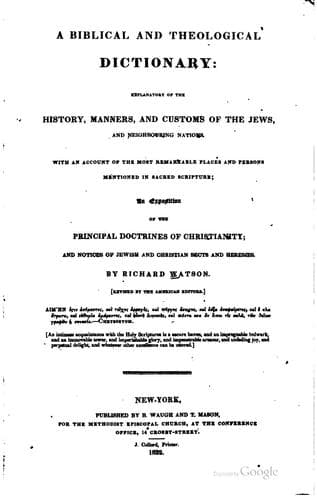
A Biblical and Theological Dictionary: explanatory of the history, manners, and customs of the Jews, and neighbouring nationsWatson, Richard
Religion
A Biblical and Theological Dictionary: explanatory of the history, manners, and customs of the Jews, and neighbouring nations
Watson, Richard
Bible -- Dictionaries; Theology -- Dictionaries
AMMONITES, the descendants of Ammon, the son of Lot. They took
possession of the country called by their name, after having driven out
the Zamzummims, who were its ancient inhabitants. The precise period at
which this expulsion took place is not ascertained. The Ammonites had
kings, and were uncircumcised, Jer. ix, 25, 26, and seem to have been
principally addicted to husbandry. They, as well as the Moabites, were
among the nations whose peace or prosperity the Israelites were
forbidden to disturb, Deut. ii, 19, &c. However, neither the one nor the
other were to be admitted into the congregation to the tenth generation,
because they did not come out to relieve them in the wilderness, and
were implicated in hiring Balaam to curse them. Their chief and peculiar
deity is, in Scripture, called Moloch. Chemosh was also a god of the
Ammonites. Before the Israelites entered Canaan, the Amorites conquered
a great part of the country belonging to the Ammonites and Moabites; but
it was retaken by Moses, and divided between the tribes of Gad and
Reuben. Previous to the time of Jephthah, B. C. 1188, the Ammonites
engaged as principals in a war, under a king whose name is not given,
against the Israelites. This prince, determining to recover the ancient
country of the Ammonites, made a sudden irruption into it, reduced the
land, and kept the inhabitants in subjection for eighteen years. He
afterward crossed Jordan with a design of falling upon the tribes of
Judah, Benjamin, and Ephraim. The Israelites resisted the invader; and,
assembling at Mizpeh, chose Jephthah for their general, and sent an
expostulatory message to the king of the Ammonites, Judges x, xi. The
king replied, that those lands belonged to the Ammonites, who had been
unjustly dispossessed of them by the Israelites, when they came out of
Egypt, and exhorted Jephthah to restore them peaceably to the lawful
owners. Jephthah remonstrated on the injustice of his claim; but finding
a war inevitable, he fell upon the Ammonites near Aroer, and defeated
them with great slaughter. On this occasion the Ammonites lost twenty
cities; and thus an end was put, after eighteen years’ bondage, to the
tyranny of Ammon over the Israelites beyond Jordan. In the days of Saul,
1 Sam. xi, B. C. 1095, the old claim of the Ammonites was revived by
Nahash their king, and they laid siege to the city of Jabesh. The
inhabitants were inclined to acknowledge Nahash as their sovereign; but
he would accept their submission only on condition that every one of
them should consent to lose his right eye, and that thus he might fix a
lasting reproach upon Israel: but from this humiliating and severe
requisition they were delivered by Saul, who vanquished and dispersed
the army of Nahash. Upon the death of Nahash, David sent ambassadors to
his son and successor Hanun, to congratulate him on his accession; but
these ambassadors were treated as spies, and dismissed in a very
reproachful manner, 2 Sam. x.
Public-domain text, read in full here on John Shaqi.
Reviews
Reviews
No reviews yet
Be the first to share your thoughts on this work.
Elsewhere in the archive
Join the Discussion
Join the discussion
Sign in to leave a comment or review.
Sign InorCreate an account