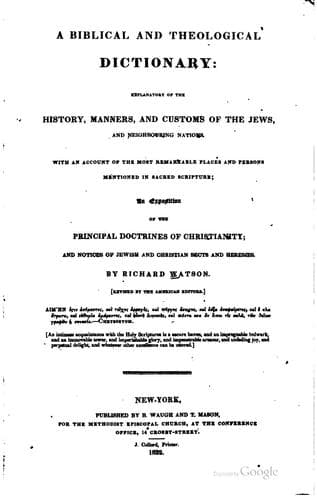
A Biblical and Theological Dictionary: explanatory of the history, manners, and customs of the Jews, and neighbouring nationsWatson, Richard
Religion
A Biblical and Theological Dictionary: explanatory of the history, manners, and customs of the Jews, and neighbouring nations
Watson, Richard
Bible -- Dictionaries; Theology -- Dictionaries
3. This will more fully appear if we consider the import of the words of
the Apostle,--“By FAITH Abel offered unto God a more excellent sacrifice
than Cain, by which he obtained WITNESS that he was RIGHTEOUS, God
testifying of his gifts; and by it, he, being dead, yet speaketh.” Now
what is the meaning of the Apostle, when he says that it was witnessed
or testified to Abel that he was _righteous_? His doctrine is, that men
are sinners; that all, consequently, need pardon; and _to be declared_,
_witnessed_, and _accounted righteous_, are, according to his style of
writing, the same as “to be justified, pardoned, and dealt with as
righteous.” Thus he argues that Abraham believed God, “and it was
accounted to him for righteousness,”--“that faith was reckoned to
Abraham for righteousness,”--“that he received the sign of circumcision,
a _seal_,” a visible confirmatory, declaratory, and witnessing mark “of
the righteousness which he had by faith.” In these cases we have a
similarity so striking, that they can scarcely fail to explain each
other. In both, sinful men are placed in the condition of _righteous_
men; the instrument, in both cases, is _faith_; and the transaction is,
in both cases also, publicly and sensibly _witnessed_,--as to Abraham,
by the sign of circumcision; as to Abel, by a visible acceptance of his
sacrifice, and the rejection of that of Cain.
Abel had faith, and he expressed that faith by the kind of sacrifice he
offered. It was in this way that his faith “pleased God;” it pleased him
as a principle, and by the act to which it led, which act was the
offering of a sacrifice to God different from that of Cain. Cain had not
this faith, whatever might be its object; and Cain, accordingly, did not
bring an offering to which God had “respect.” That which vitiated the
offering of Cain was the want of this faith; for his offering was not
significant of faith: that which “pleased God,” in the case of Abel, was
his faith; and he had “respect” to his offering, because it was the
expression of that faith; and upon his faith so expressing itself, God
witnessed to him “that he was righteous.” So forcibly do the words of
St. Paul, when commenting upon this transaction, show, that Abel’s
sacrifice was accepted, because of its immediate connection with his
_faith_, for by faith he is said to have offered it; and whatever it
might be, which made Abel’s offering differ from that of Cain, whether
_abundance_, or _kind_, or both, this was the result of his faith. So
evident also is it from the Apostle, that Abel was witnessed to be
“righteous,” not with reference to any previous “habit of a religious
life,” as some say, but with reference to his _faith_; and to this faith
as expressing itself by his offering “a more excellent sacrifice.”
Public-domain text, read in full here on John Shaqi.
Reviews
Reviews
No reviews yet
Be the first to share your thoughts on this work.
Join the Discussion
Join the discussion
Sign in to leave a comment or review.
Sign InorCreate an account